I was super-eager to attend my first Percona Live as a Perconian. While I was supposed to be at the one in the US in May, my life was overtaken by events and I didn’t make it, so this was my first chance to attend since the one in Denver back in 2023.
TL;DR; The Amsterdam version of Percona Live was the second such event in 2026 and brought together hundreds of open source database enthusiasts. It was a blast. If you want to experience it yourself you can click on the 🎥 icon next to the description and watch the video. Not all videos have been posted, yet.
Even though “Percona” is featured prominently in the conference’s name, and there are a number of keynotes focused on the business, the conference itself has a much wider audience and serves as a forum for any open source database topic - it’s not just a single vendor event. It reminds me a lot of the Open Source Monitoring Conference (celebrating its 20th year by the way) that is sponsored by Netways but not dominated by them.
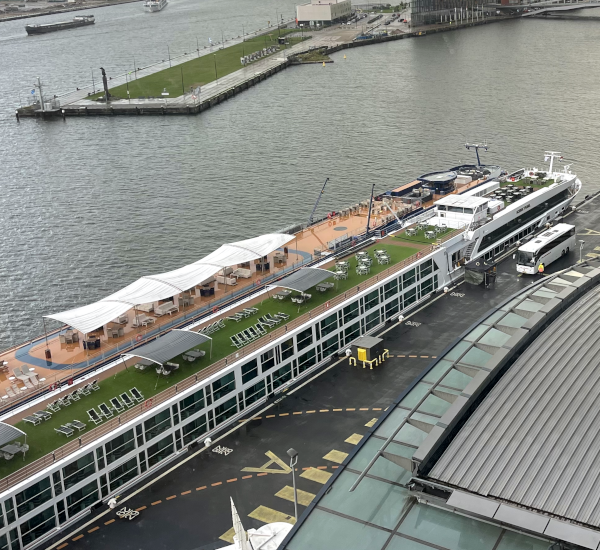
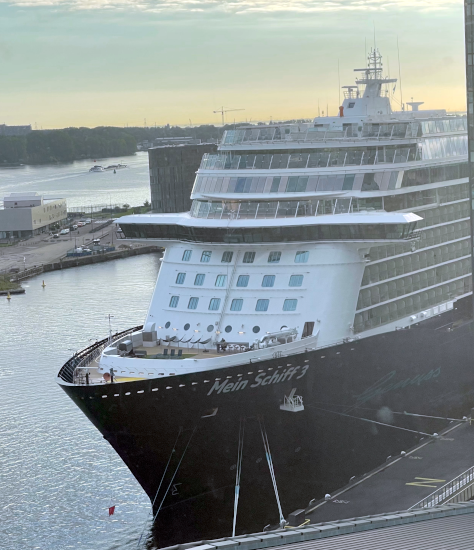
For this year’s European iteration the venue was Amsterdam, which is a pretty cool city. The conference hotel was very close to the Central Station as well, and I would often see cruise ships (both ocean-going and river) from my room’s window.
 |
 |
I got there a day early to adjust to the timezone, and while most of the planes I’m on these days are completely booked, on the flight out I had a whole row (three seats) to myself so I arrived rested.
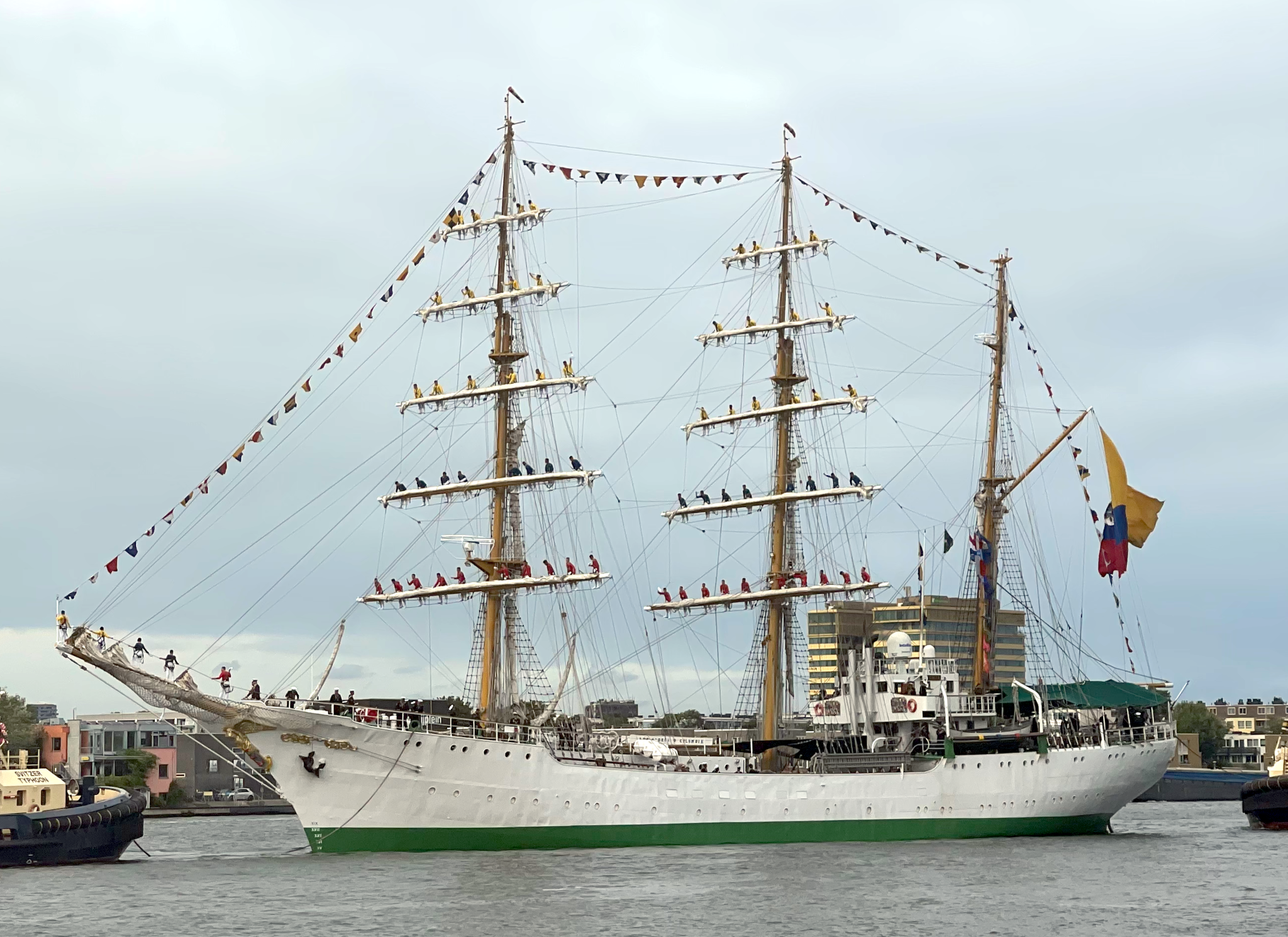
I had a little time to wander around and saw this tall ship headed out to sea. The little dots on the crosstrees are people getting ready to lower the sails (I saw them earlier geared-up in their harnesses).
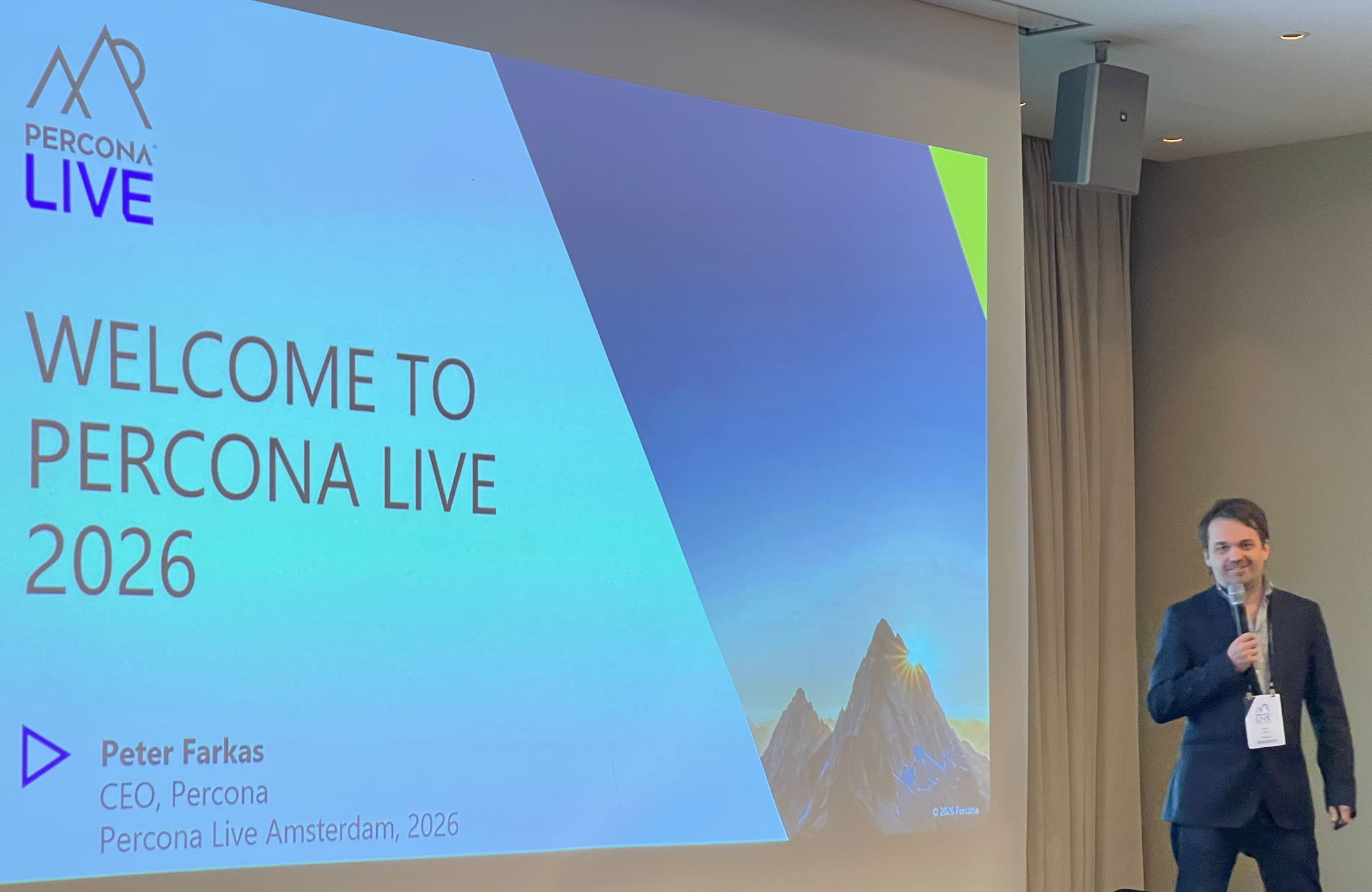
The official start of the conference was on Wednesday, and it was kicked off by our CEO, Peter Farkas. 🎥
He welcomed everyone and talked about the importance of how open source gives users control over their technology choices, and our role (everyone in the room, not just Percona) in making open source successful.
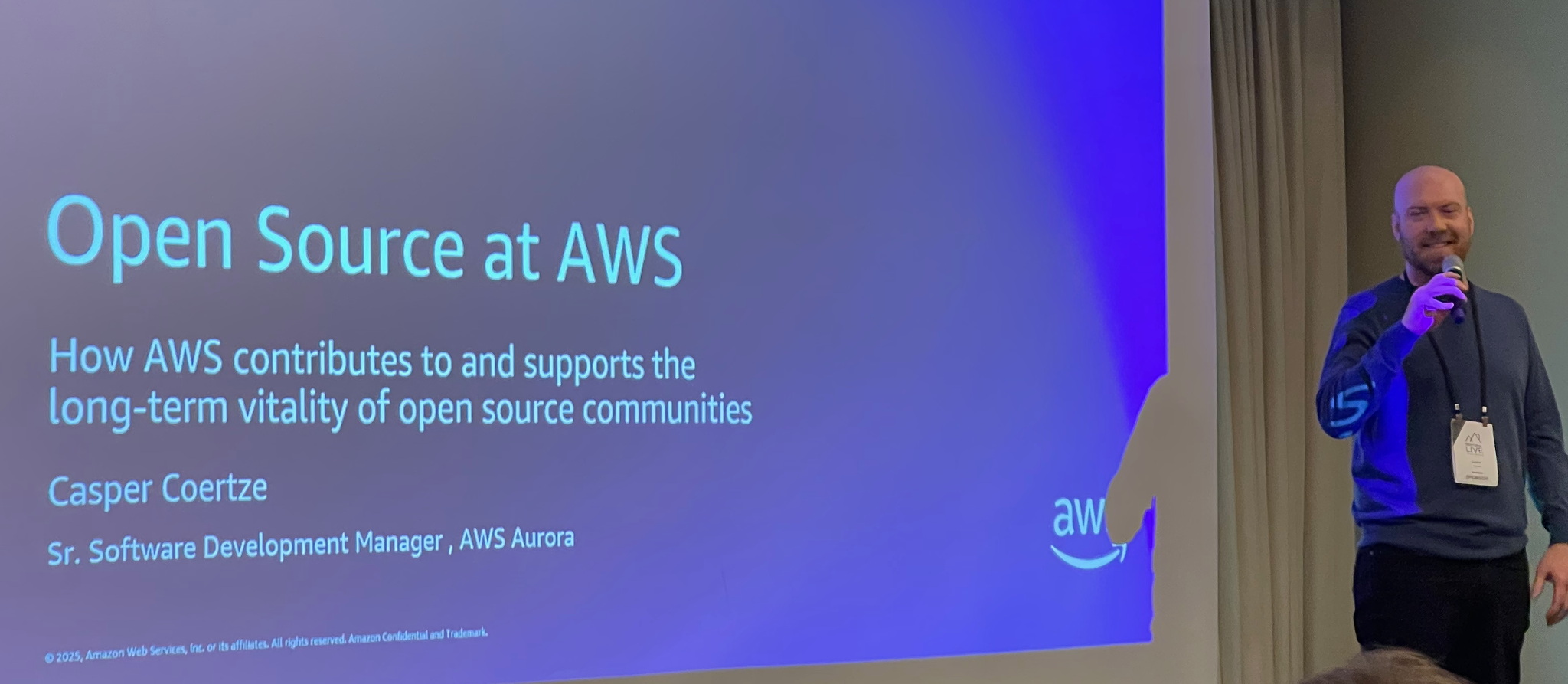
The next talk 🎥 was by Casper Coertze of AWS, one of the Platinum sponsors of Percona Live. He talked about how AWS contributes to upstream projects. I never worked with Casper when I was at AWS, and I had some serious frustration with AWS projects that didn’t contribute upstream, but when it comes to open source relational databases, AWS does get involved. Next week I’ll be in NYC for PostgreSQL Summit and I’m looking forward to seeing Joe Conway, who runs a team at AWS dedicated to upstream contributions to that database. In my own focus area, MariaDB, AWS is always one of the top contributors, after MariaDB plc and the Foundation itself (I’m eager for Percona to join that list in 2027).
AWS was also instrumental in the creation of Valkey, an open source fork of the Redis key-value in-memory database.
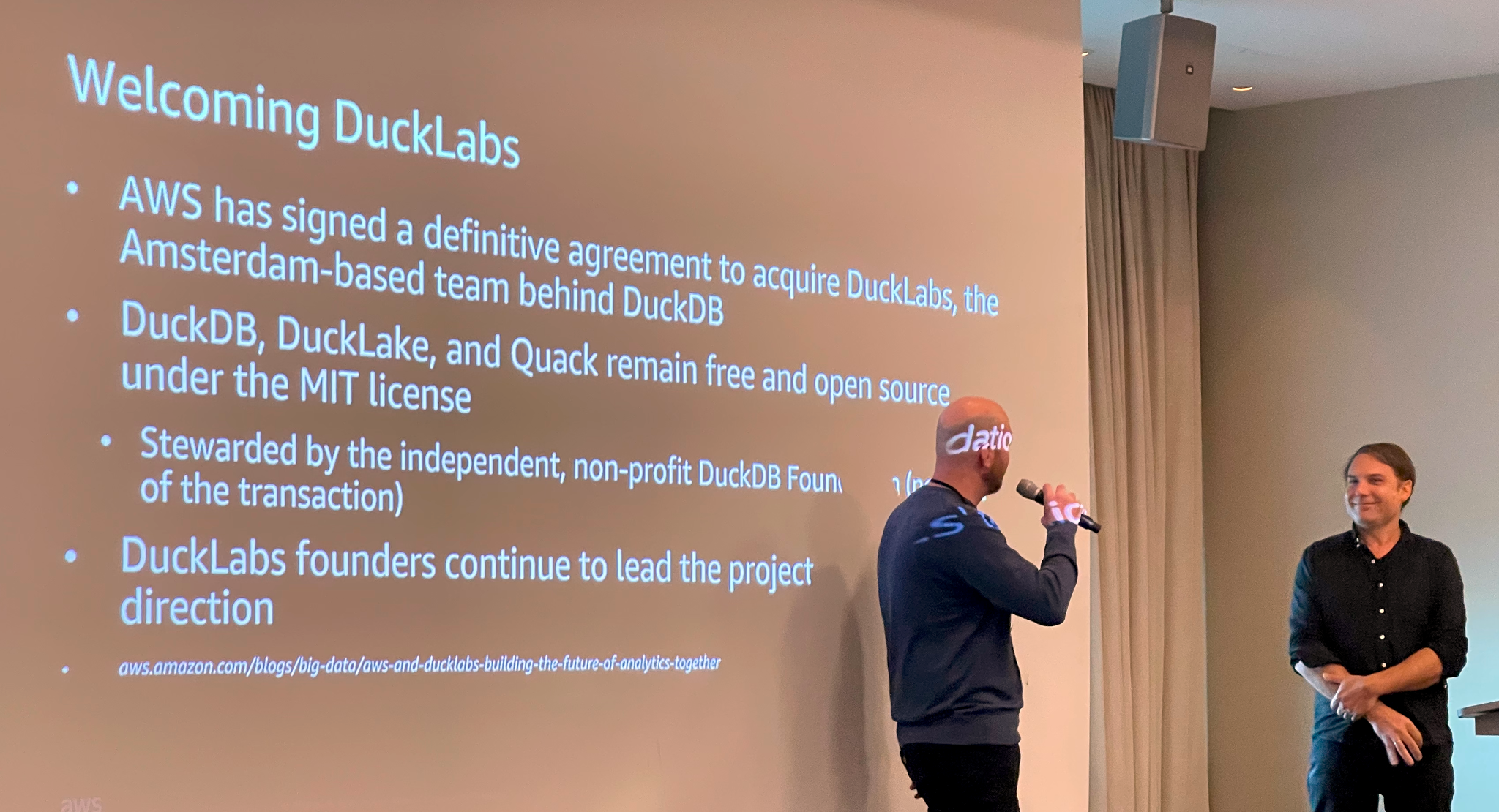
And in one of the bigger announcements recently, AWS has acquired DuckLabs, the company behind DuckDB. I had worked to get Hannes Mühleisen to Percona Live for a fireside chat coming up on Friday, and it was nice to see him take the stage to talk about the opportunities the acquisition provides for the future success of their open source projects.
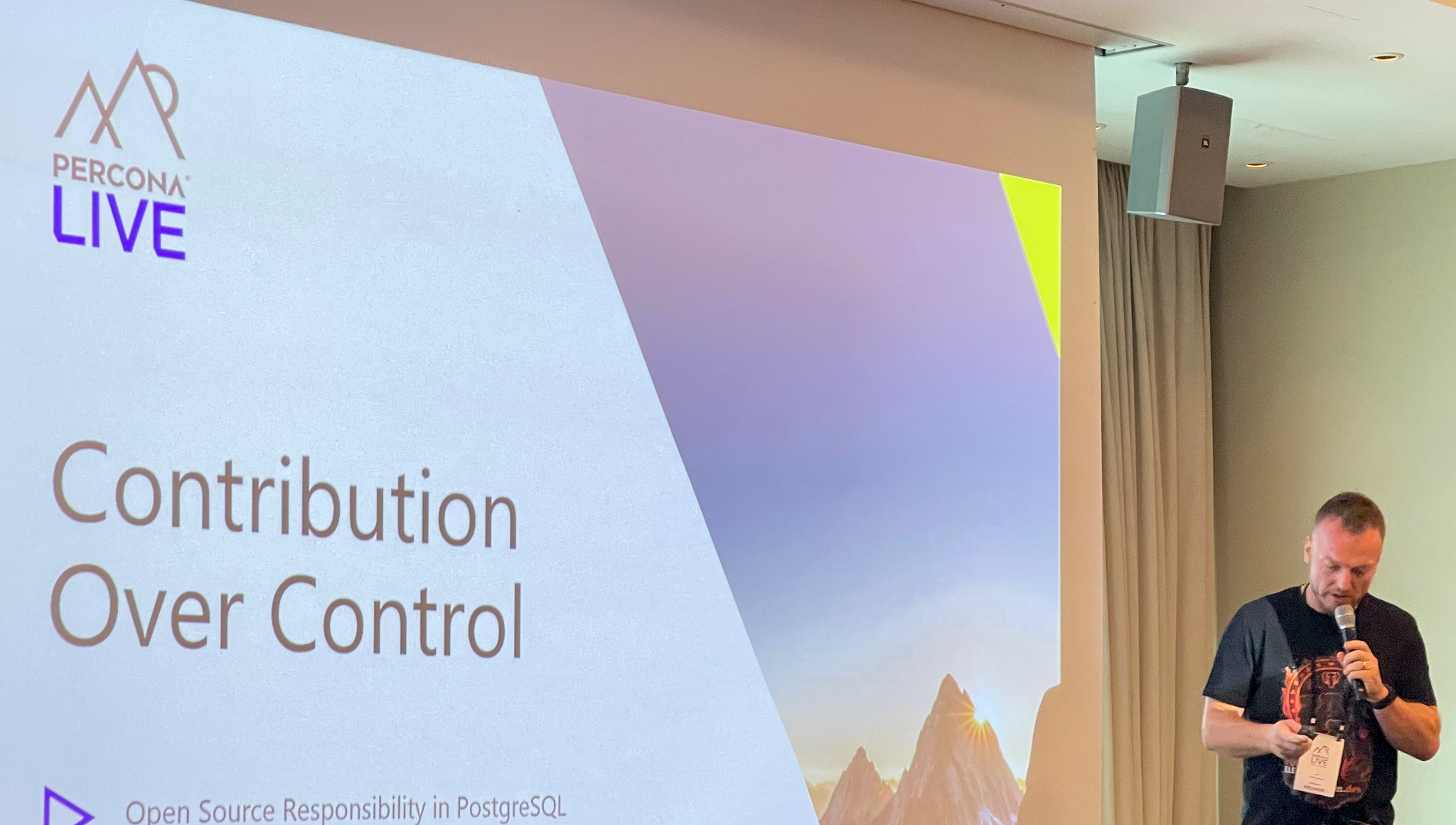
Creating survivable open source projects is hard, which leads right into the next talk 🎥 by Jan Wieremjewicz on “Contribution Over Control” with respect to PostgreSQL.
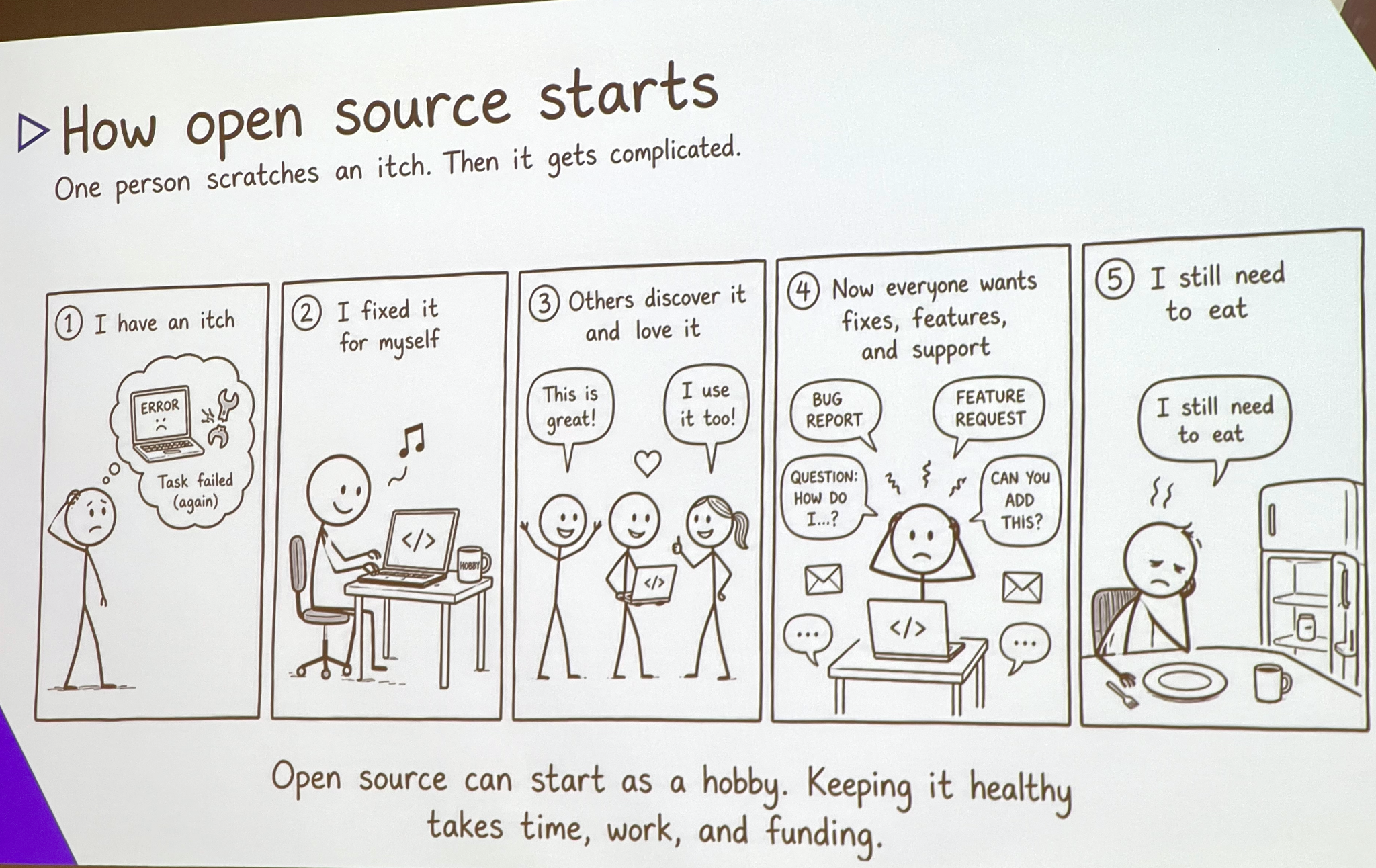
He presented a great comic that kind of illustrates the problem.
What community members want to work on, in many cases just for fun, may not line up with the needs of larger organizations. Those companies require things like security, compliance and reliability at scale which may not be addressed by a project’s community.
Jan talked about Percona’s approach to contributions, starting with the users and then building from there, while at all times working to keep the solution open.
The final keynote 🎥 of the morning was given by Peter Zaitsev, one of Percona’s founders, on Open Source Database Operations in the Age of AI.
He talked about how the load on databases (not necessarily just ones that are open source) changes in an AI-rich environment. AI agents tend to spawn way more queries than a normal person or application, and that will impact how open source databases are used.
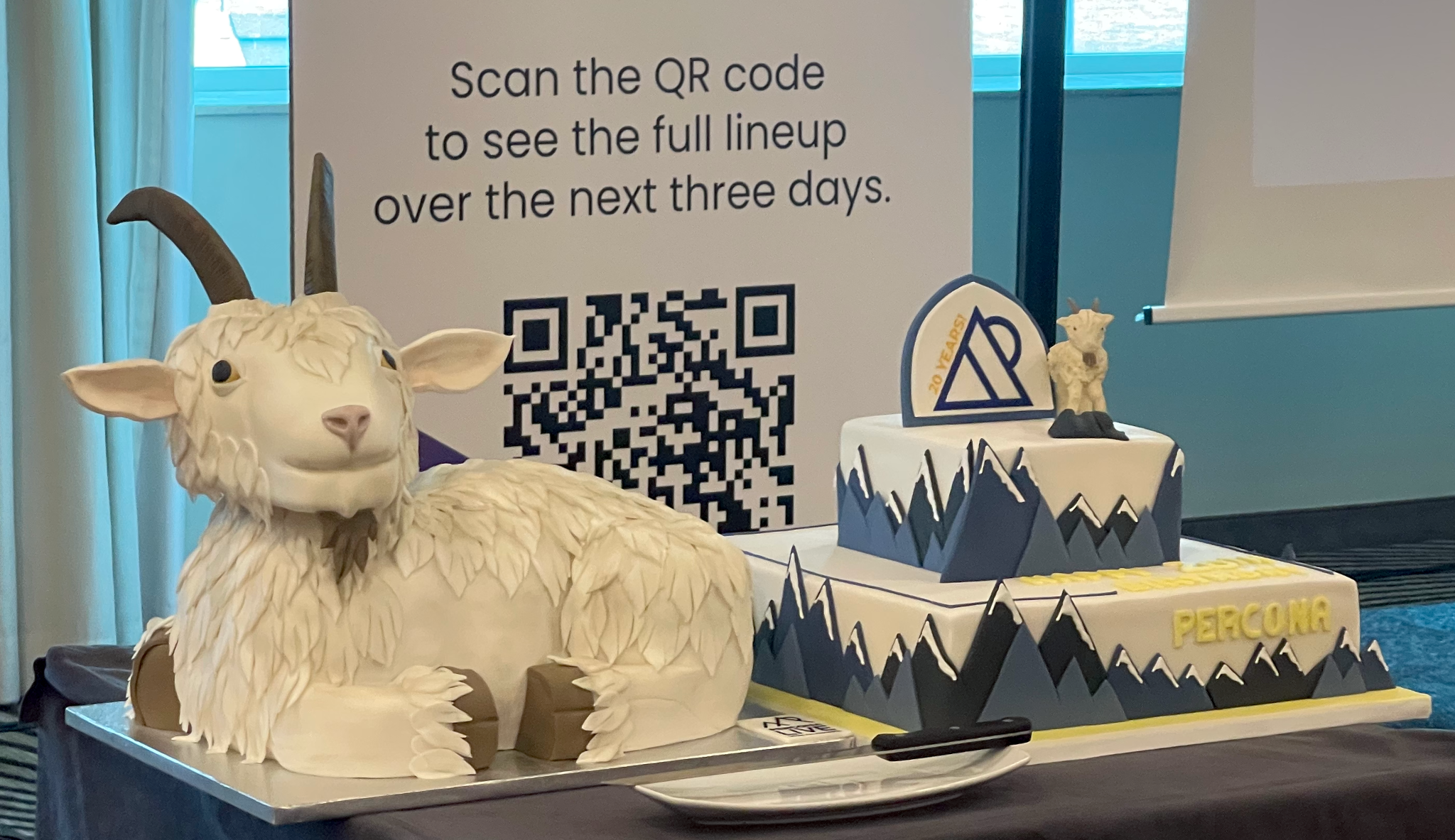
This was followed by … cake! This year marks the 20th anniversary of the founding of Percona, and it was celebrated with a “goat” cake.
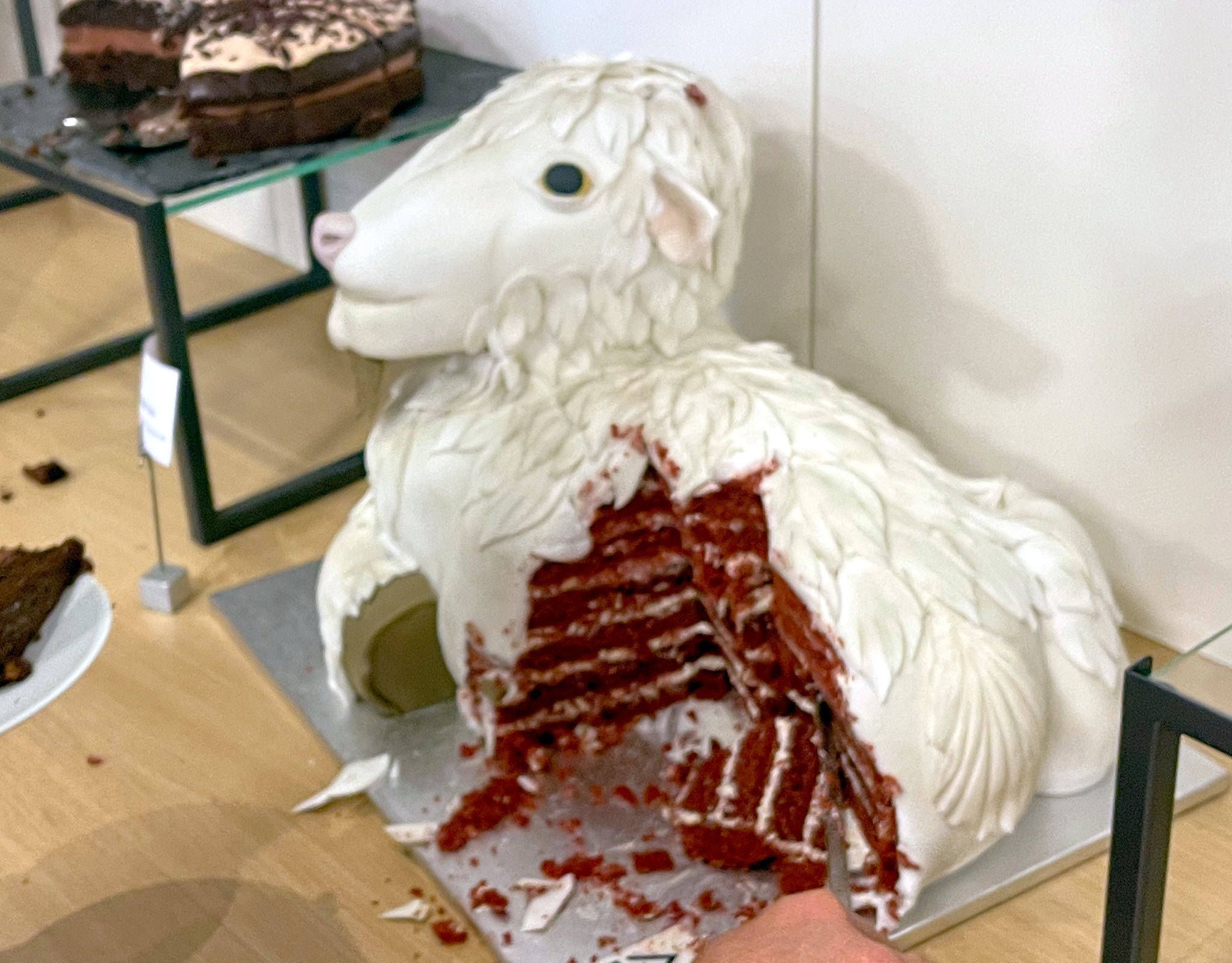
And yes, it was red velvet.
When I first looked at the Percona Live schedule, I was eagerly awaiting the next talk “Congratulations, You’re Now a MariaDB DBA”. In every business I’ve been a part of I’ve tried to work backwards from the customer, and I wanted to get a read on MariaDB from the point of view of actual users.
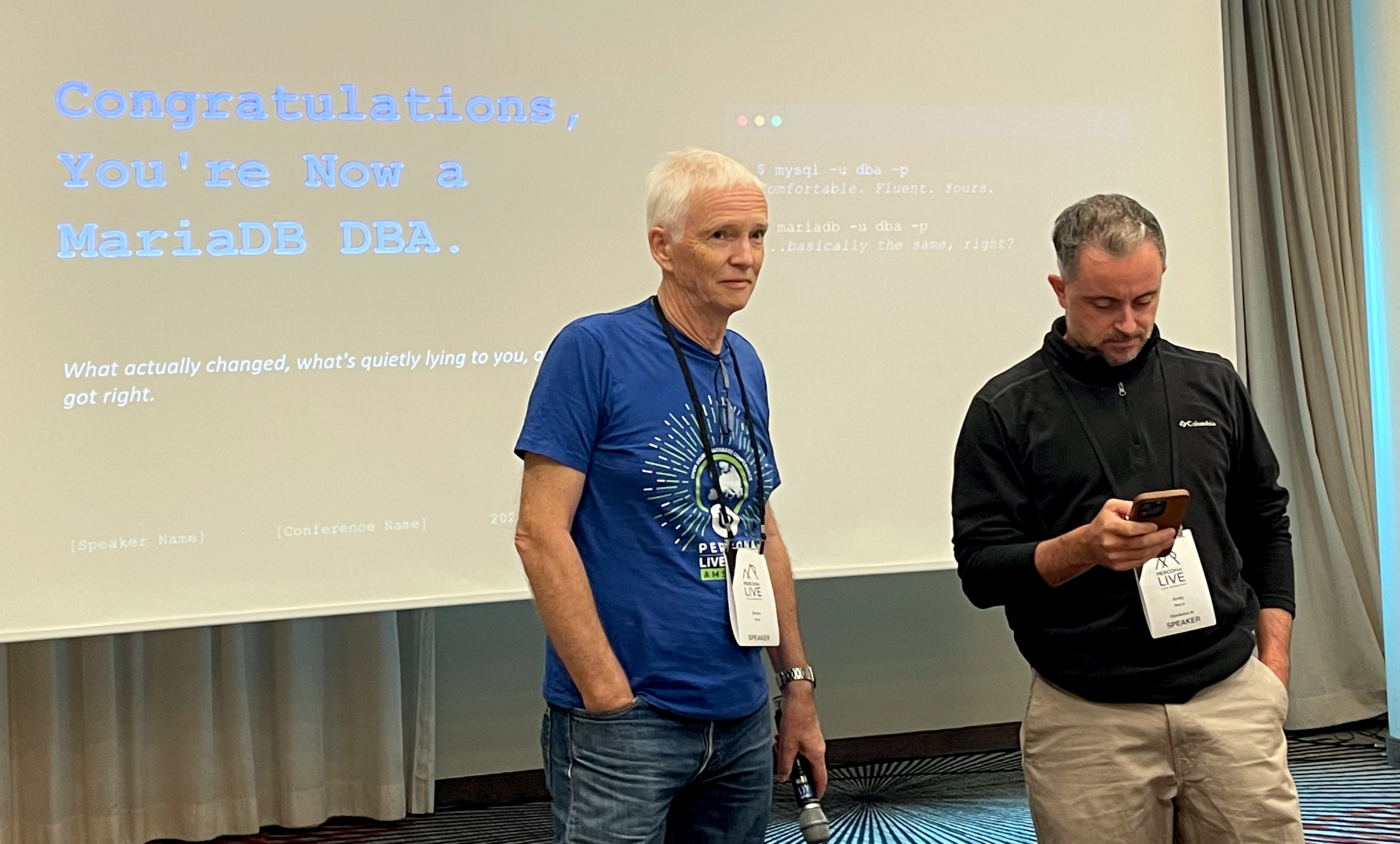
Given by Simon Mudd and Andy Moore, this talk 🎥 covered the major differences between MySQL and MariaDB from the point of view of database administrators. It was awesome, and did more to showcase MariaDB than anything else I’ve seen lately.
While I took a picture of almost every slide, I won’t reproduce them all here, but wanted to point out a few that made me sit up and take notice.
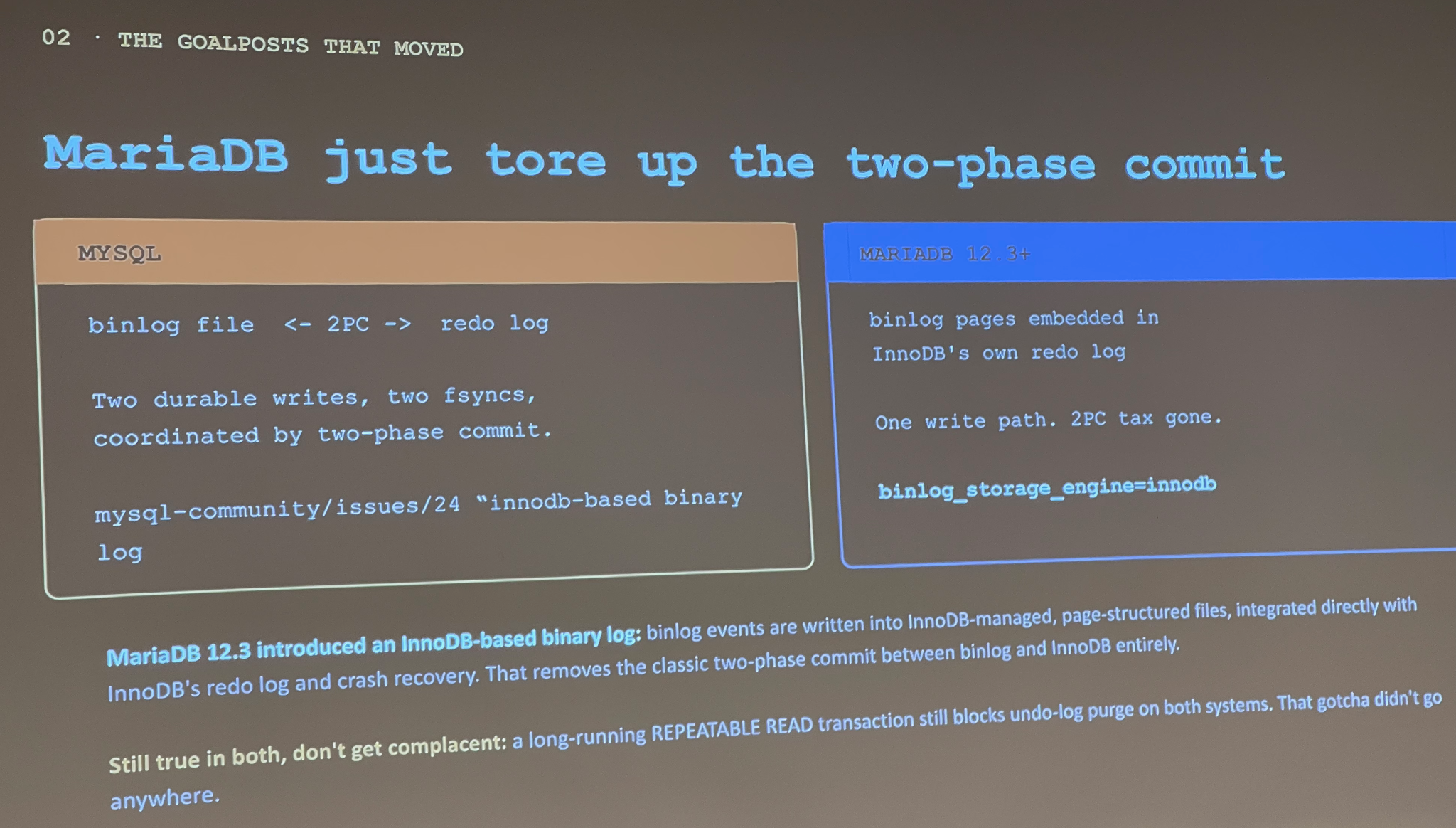
The binary log (binlog) is a set of log files that record all changes to the database, including updates, deletions, and schema changes. It is very useful, especially for replication and data restoration in case of a failure. But as you can imagine there is some overhead to writing every transaction to a log file and to the database. MariaDB got rid of this “two phase commit” by writing the log to InnoDB directly.
One of the more controversial differences is that MariaDB disables the Performance Schema by default.
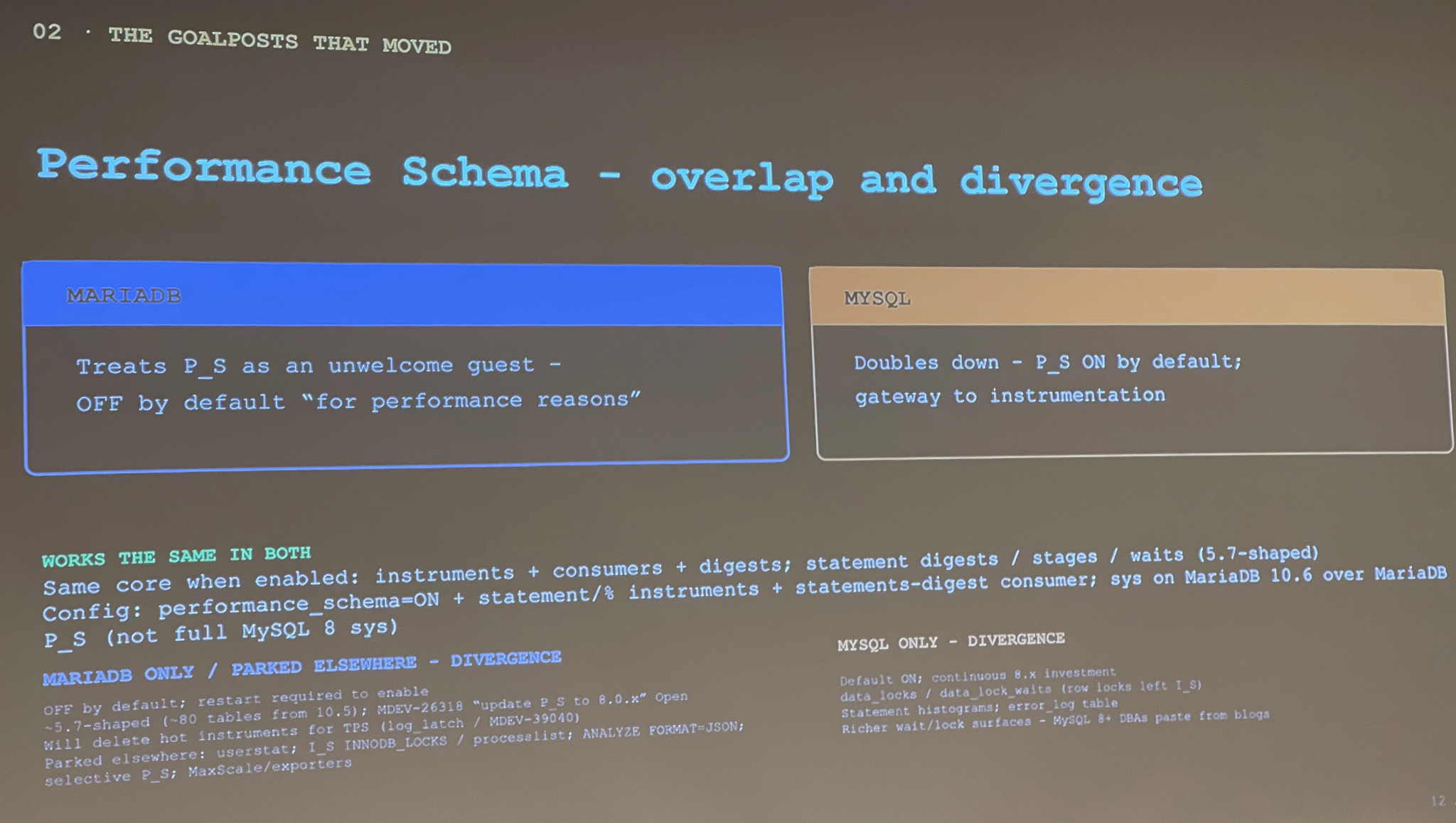
The Performance Schema (PS) is a built-in monitoring feature that inspects server execution at a low level. It provides detailed runtime performance data such as query execution times, I/O waits, lock contention, and memory usage without changing server behavior or requiring external agents.
I talked to a number of people about this and the camps were very divided. Some people said they would never run a database without PS because there is no other way to find performance issues, and others said they would never run it because it slows the database down way too much.
I immediately thought, hey, why don’t you just turn it on and off as needed? Then I learned that doing so requires a database restart (sigh).
This gave me the idea to explore a feature where the PS could be on but with zero instrumentation on by default. There should then be a way to turn on instrumentation while diagnosing an issue and then turning it off again to avoid the performance impact.
It is probably too difficult to implement but it is something I’d like to explore.
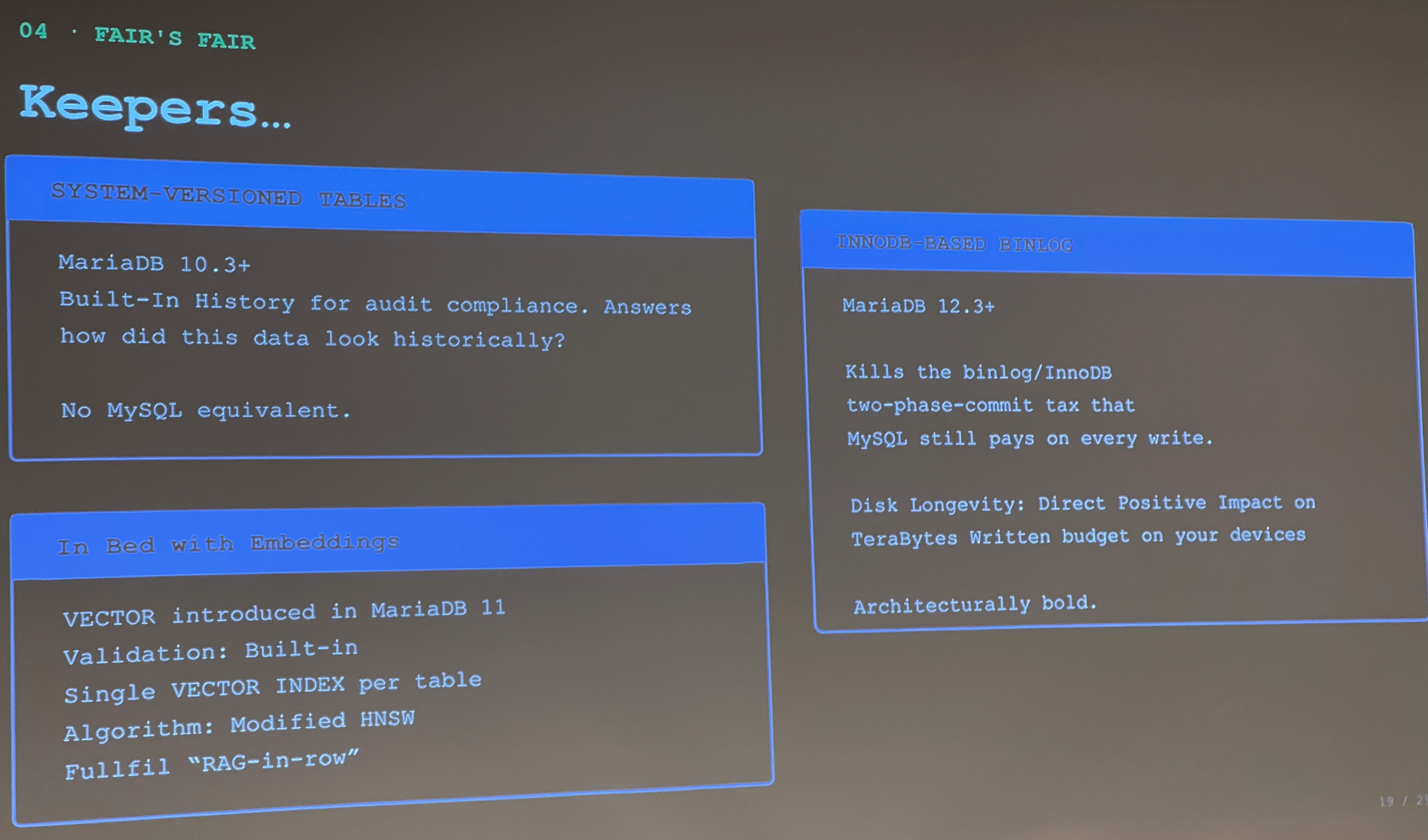
They also touched on using MariaDB as a vector database. Introduced in MariaDB 11, the VECTOR data type also includes the ability to do queries which makes the data type actually useful.
There were many more things discussed, several above my head, but it did make me very bullish on MariaDB from not only a feature perspective but a performance one as well (more on that, later).
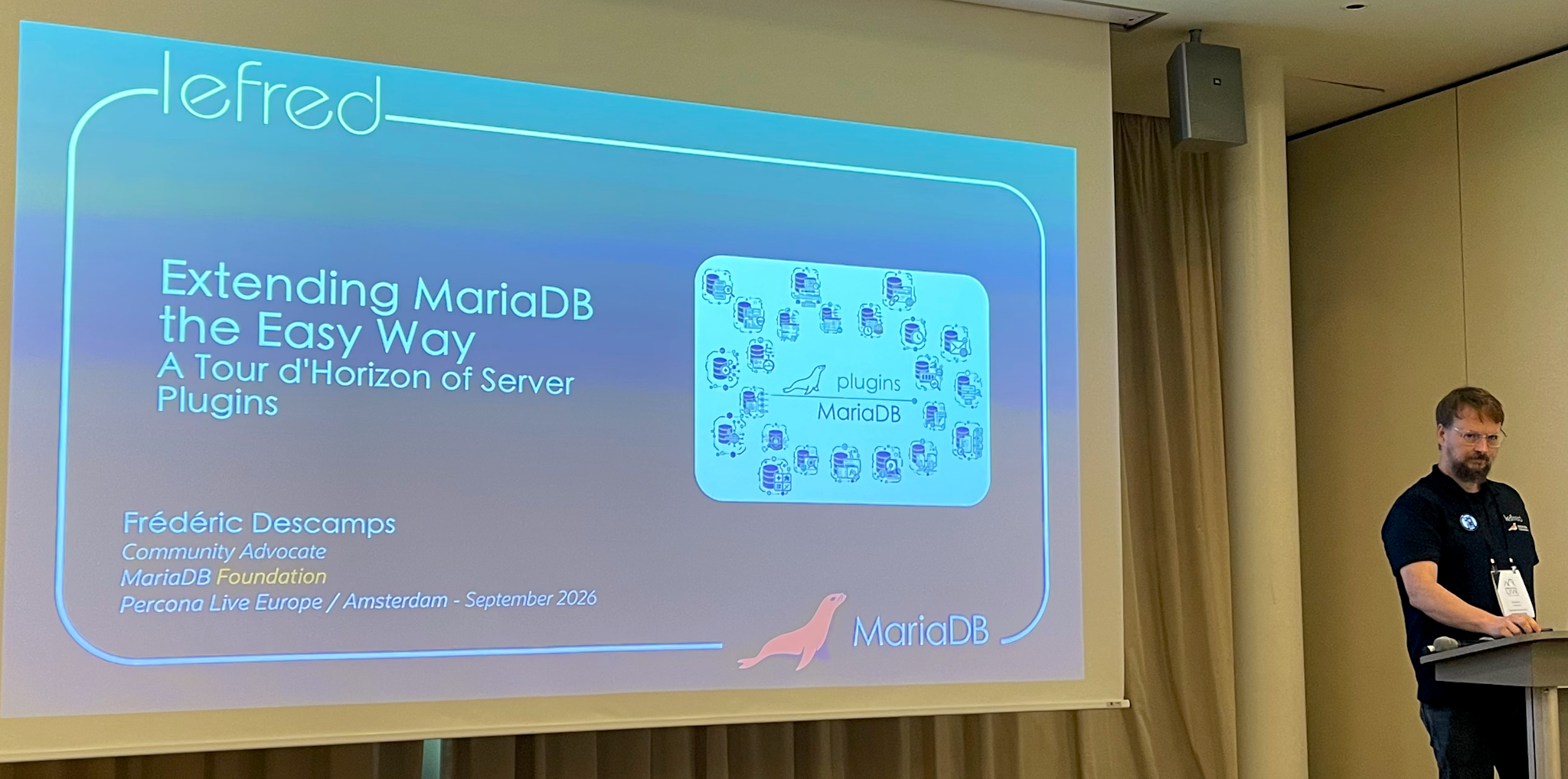
My next session 🎥 was by Frédéric Descamps (lefred) on the MariaDB plugin ecosystem. Plugins are a great way to extend the functionality of a database without having to get deep into the code.
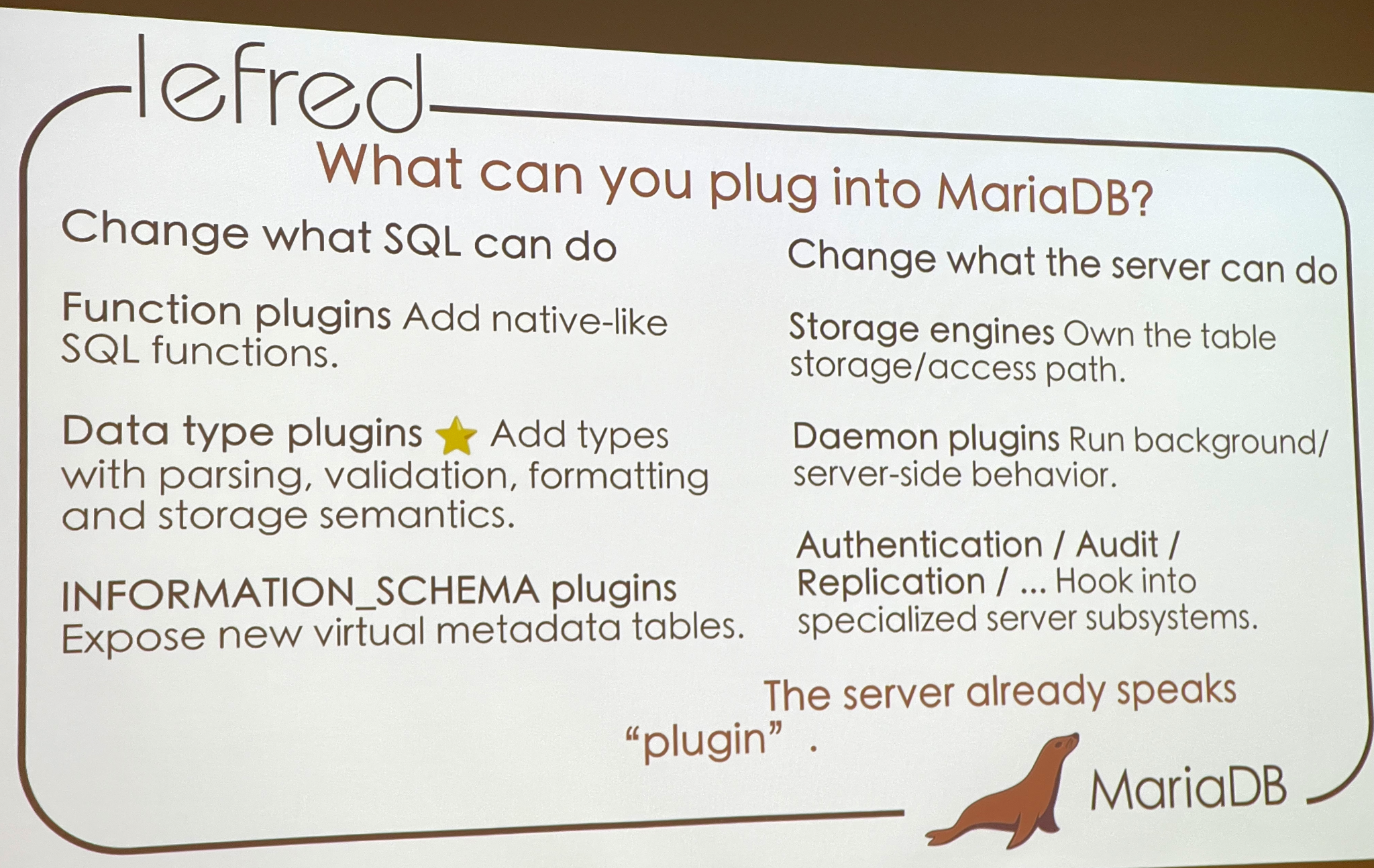
MariaDB plugins can do a lot: from adding SQL functions to data types to even storage engines. lefred demonstrated this by adding a simple data type to MariaDB, and it was only a few lines of code.
Then it was time for lunch. I made the mistake of filling up my plate at one buffet line where the food was really good but it leaned hard on vegetables. I didn’t realize there was an entirely different buffet available in the expo area with more options. I didn’t make that mistake on the following days. (grin)
My favorite track at any conference is the hallway track, and I spent much of the time after lunch simply talking with people. It was a really great crowd with folks from all over the world. I almost always feel at home at open source conferences no matter the subject or where they are held. Our community just seems to attract the best people.
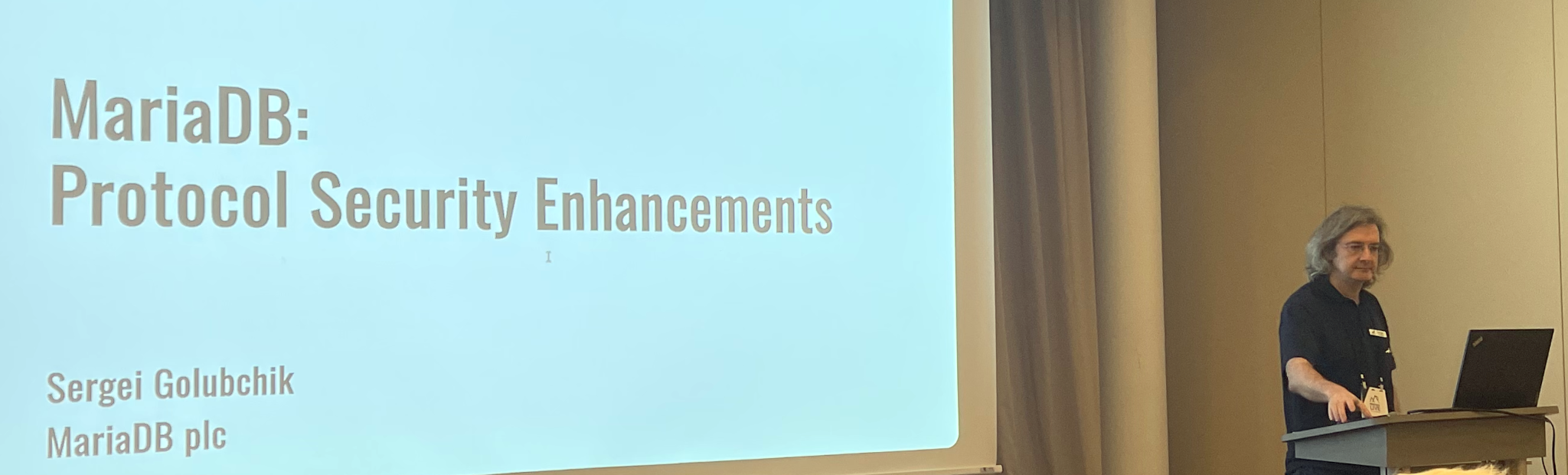
I did see one more MariaDB-focused talk 🎥 by Sergei Golubchik on security enhancements in the protocol between clients and the database.
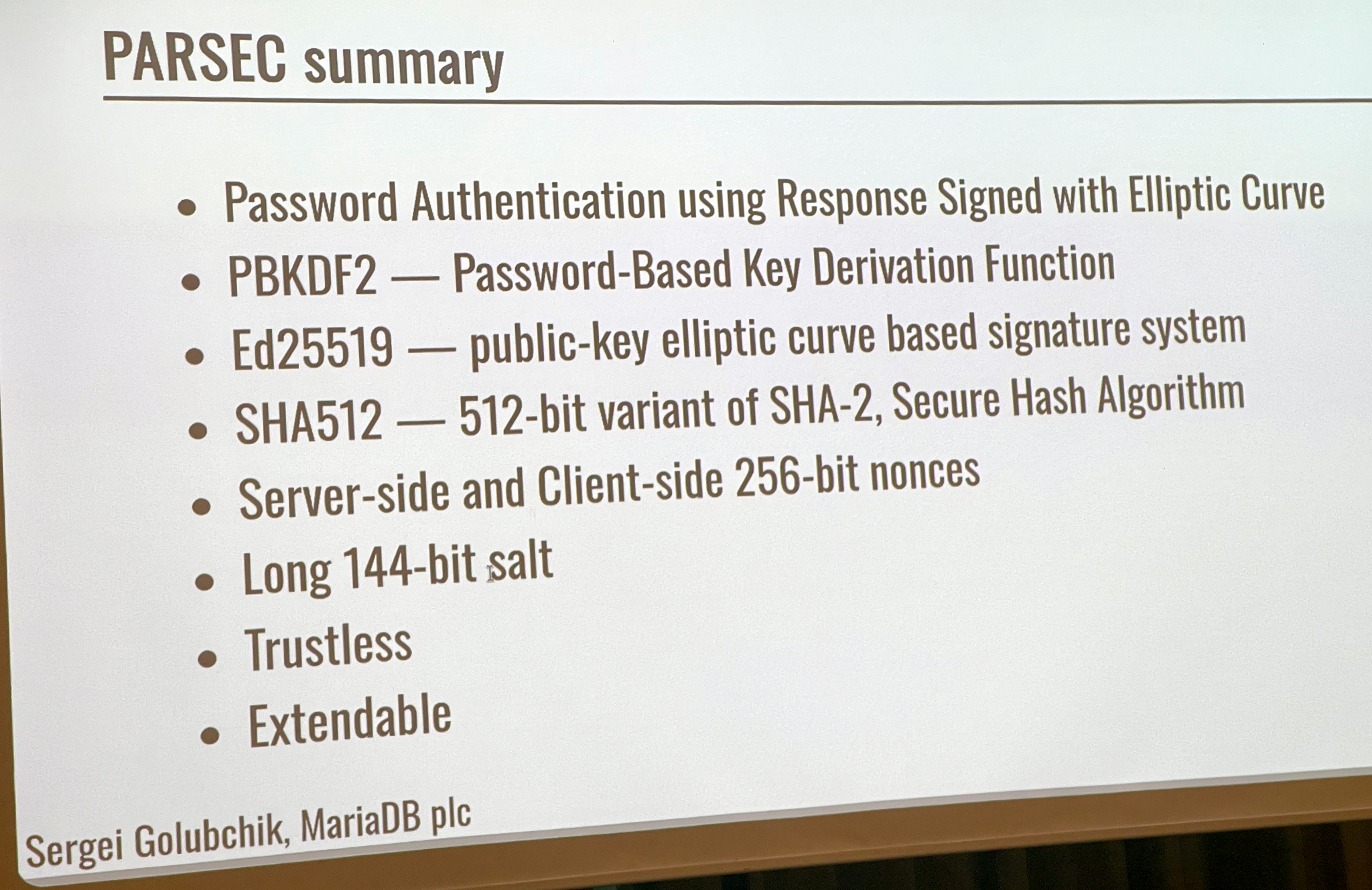
With more and more sensitive data being stored every day, having a secure connection between those applications that consume the data and where the data is stored is paramount. Sergei talked about how this was addressed in MariaDB Server in such a way to maximize security while minimizing the hassle.
The first day sessions were followed by an evening “booth crawl” in the expo area with drinks and food. It gave folks some more time to socialize and was a good way to end the day.
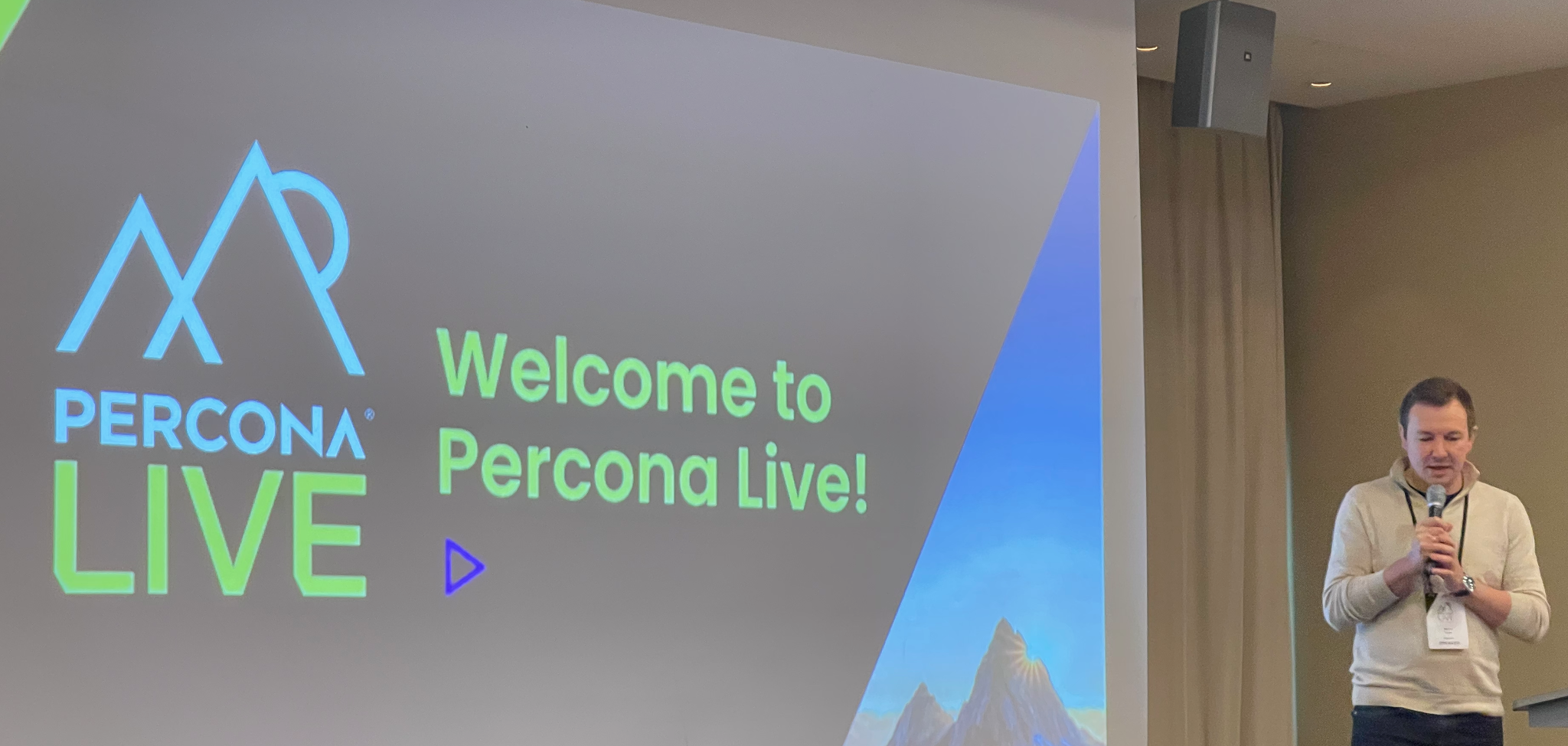
Day Two started off with Michal Nosek serving as the Master of Ceremonies. After welcoming everyone back we jumped right into the keynotes.
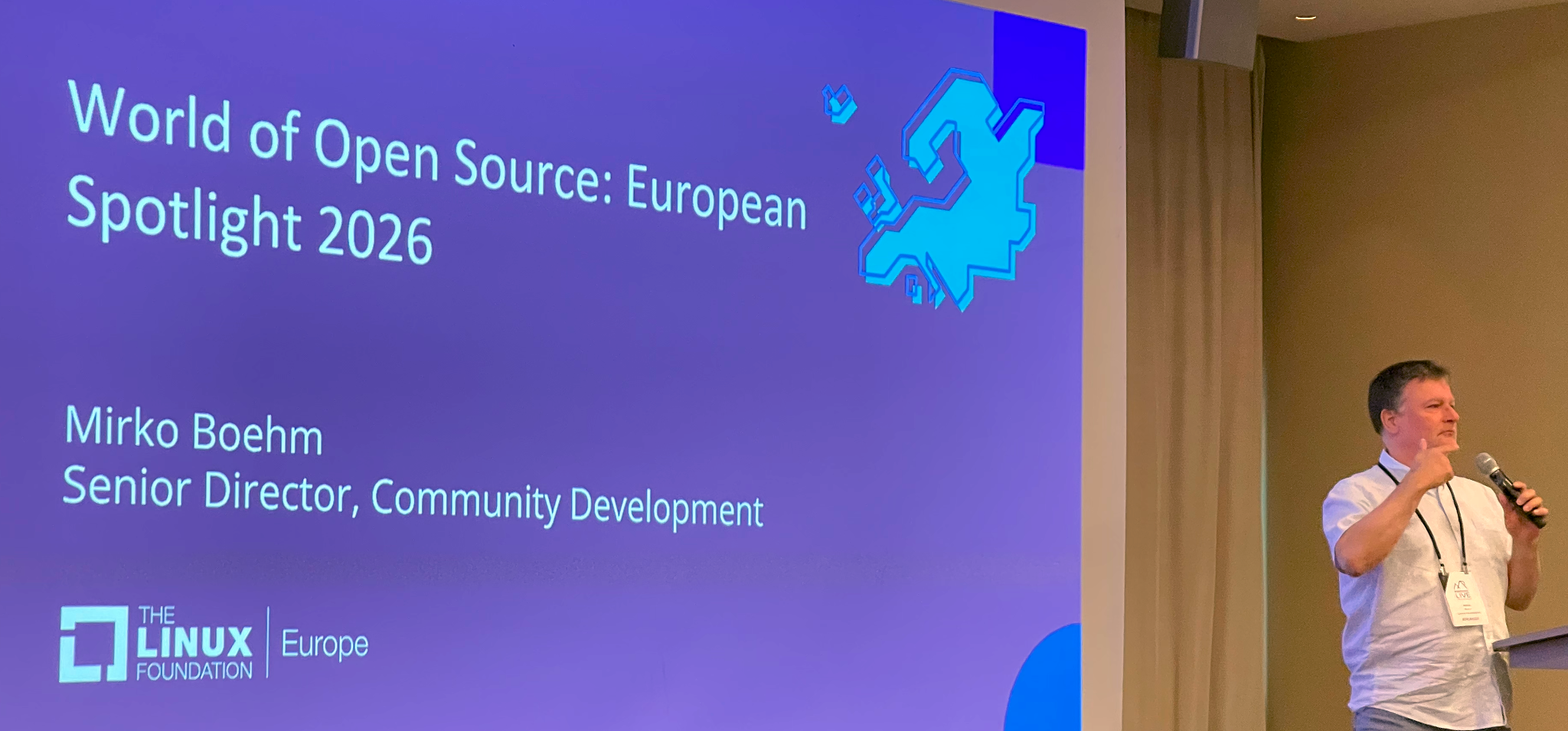
Mirko Boehm of the Linux Foundation - Europe, kicked us off with a presentation 🎥 on data the LFE collected concerning open source adoption and contribution. A lot of it was focused on AI but one slide caught my eye about why organizations that use open source don’t contribute changes back upstream.
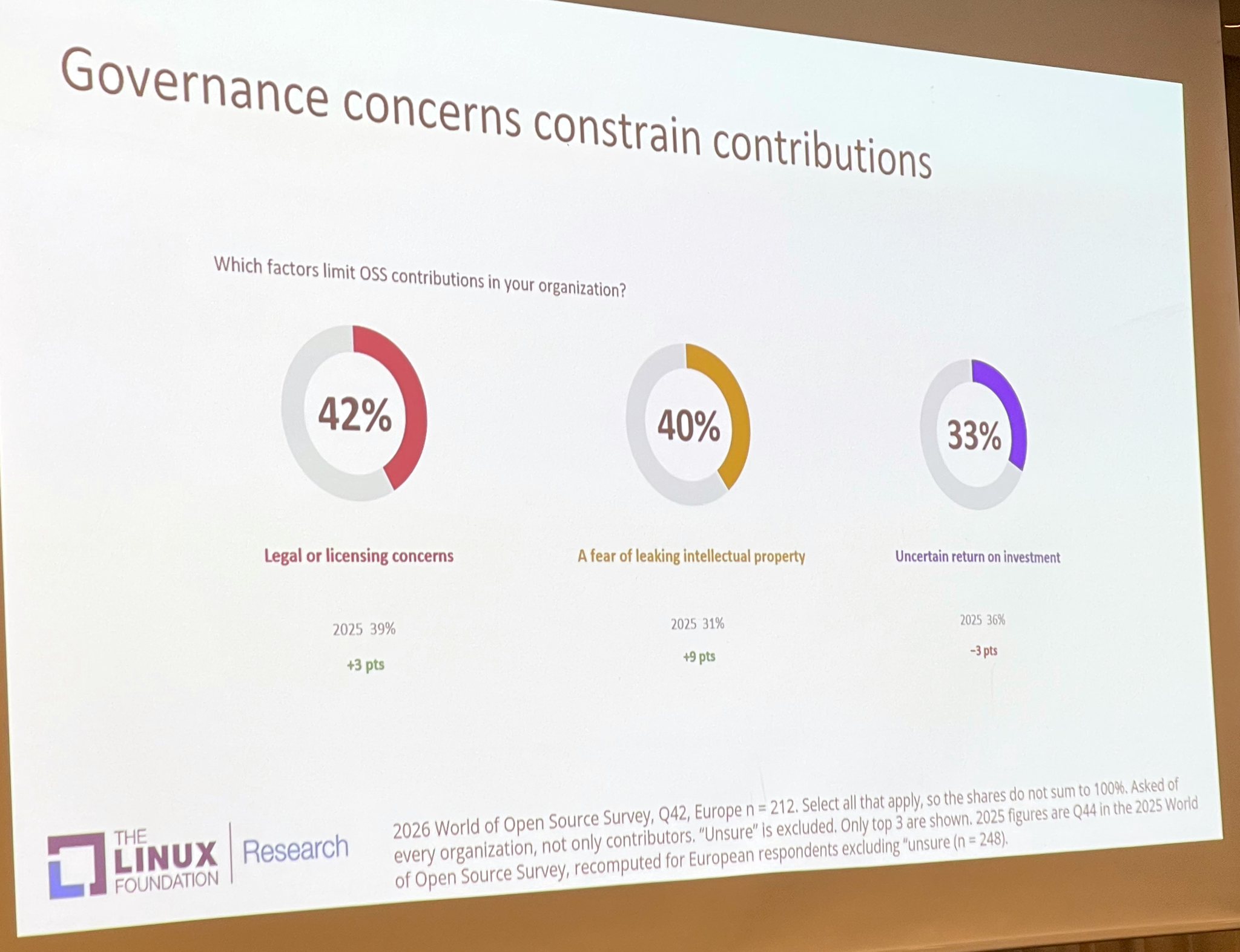
While the numbers don’t surprise me, I did like the three questions. Both legal concerns and fear of leaking intellectual property increased over the last year, whereas return on investment ticked down a bit. I guess that is a good sign. It is easy to make the argument that participating in open source communities is a Good Thing™ but much harder to get companies to actually do it.
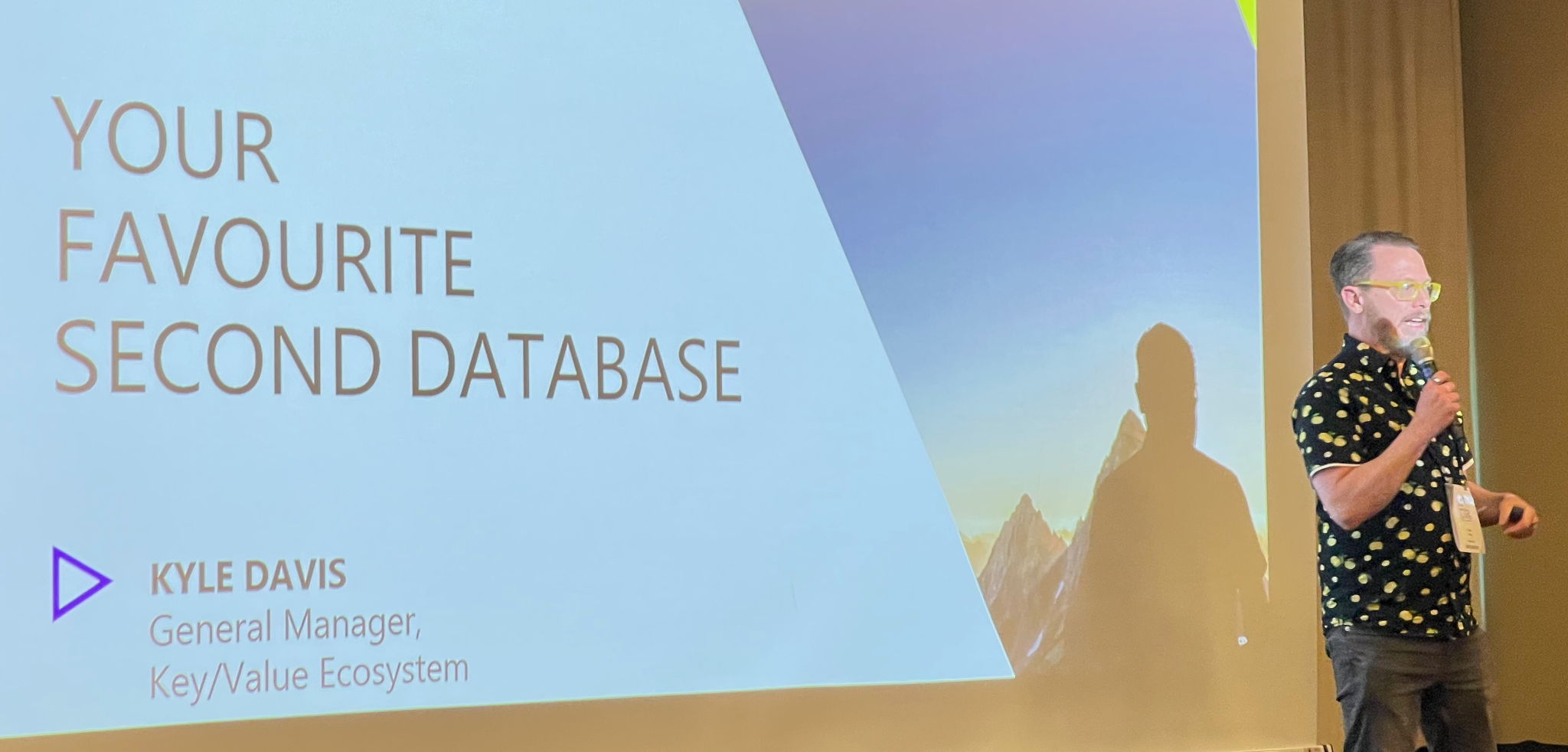
The next presentation 🎥 was by fellow GM Kyle Davis. Kyle runs Percona’s key/value database practice, and his talk focused on how in-memory databases like Valkey can act as a caching layer directly alongside a traditional relational database which can help reduce the need for expensive hardware upgrades in order to scale.

Tibor Köröcz followed with a session on Percona Monitoring and Management (PMM) 🎥. As someone who spent most of their professional life in the network monitoring space, I can’t stress enough how important I find monitoring. I just looked and I’m monitoring 63 devices on my home network, and if I didn’t I would have no clue one or more of them were down until I went to use them. In a professional setting downtime or performance degradation translates directly to lost revenue. Tibor talked about the current and future direction of PMM, which is improving on the “management” part of PMM. This will allow for PMM to take action when issues arise versus just reporting on them.
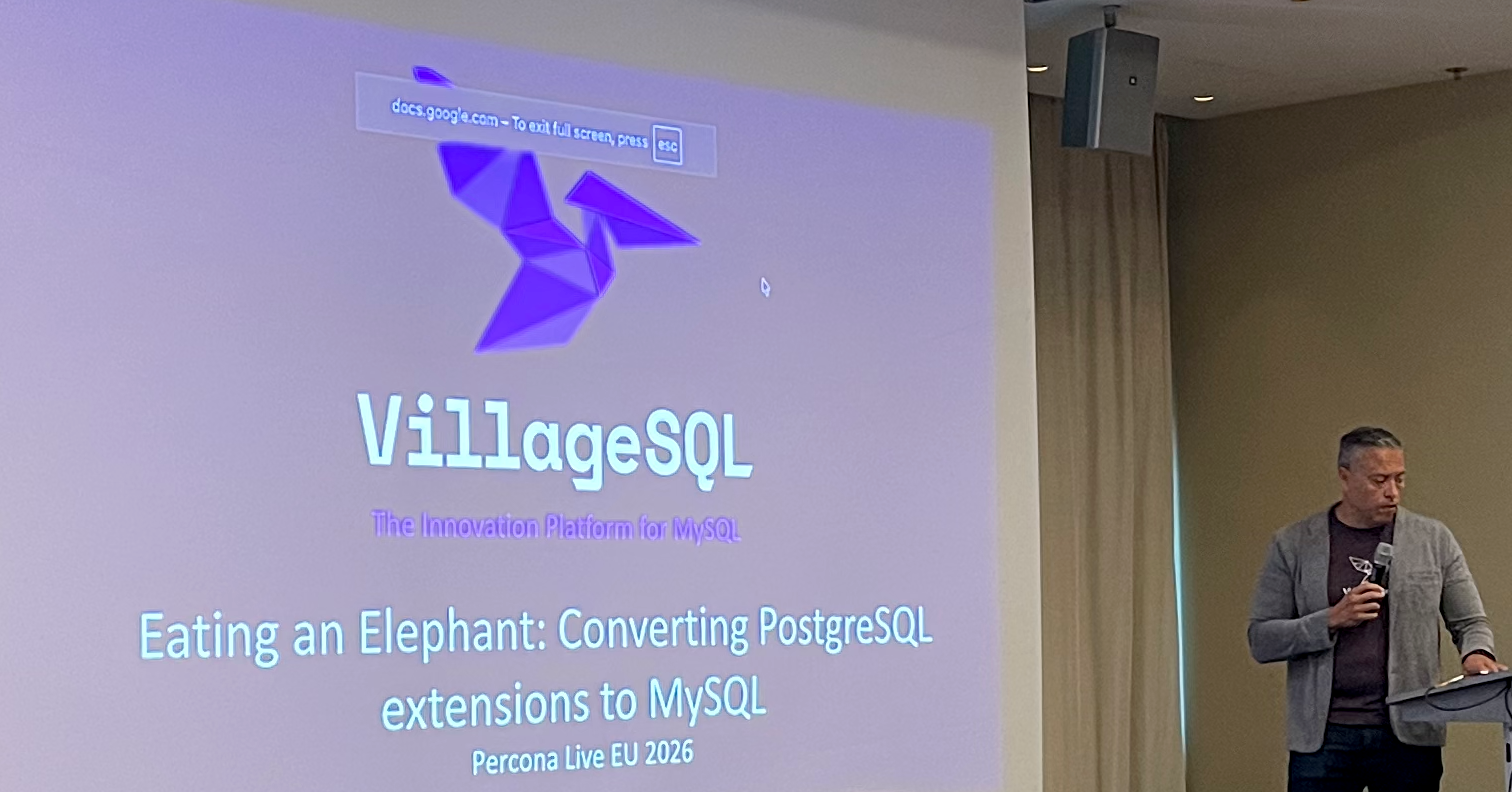
Dominic Preuss, from the conference’s other Platinum sponsor, VillageSQL, took the stage next 🎥. I was first introduced to VillageSQL back in January. Their product is a tracking fork of MySQL with a robust extension framework added. Both PostgreSQL and MariaDB have a strong plugin/extension system and the goal of VillageSQL is to bring that level of extensibility to MySQL. This talk discussed how they were converting extensions originally written for PostgreSQL to VillageSQL.
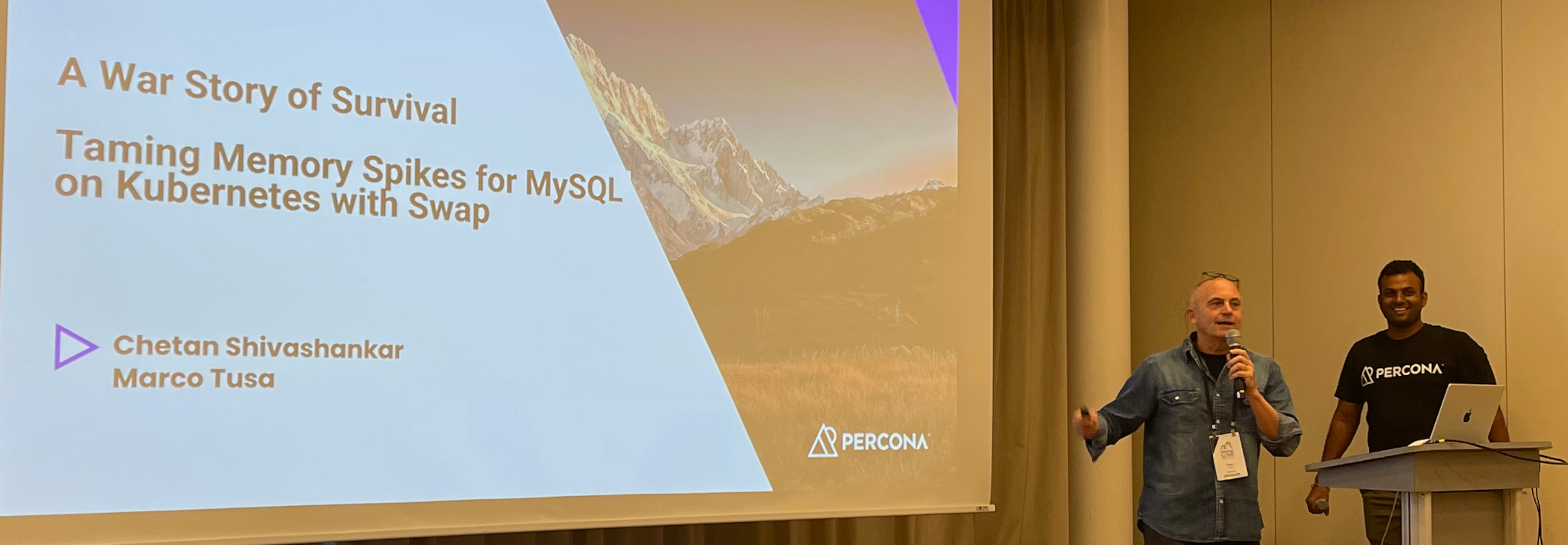
After the keynotes I was able to attend a number of sessions. The first one 🎥 was by Chetan Shivashankar and Marco Tusa talking about using swap to address memory spikes when running MySQL on Kubernetes.
Swap was originally created to help prevent systems from running out of memory. The goal was to move information residing in memory (but preferably not being actively accessed) to disk in order to free up more physical memory for active processes. Later, when that memory needs to be read, it can be “swapped” back. This session showed how swap can be used with Kubernetes to handle memory spikes, which can keep the database from being killed, although it is not a long-term solutions for systems that simply need more memory.
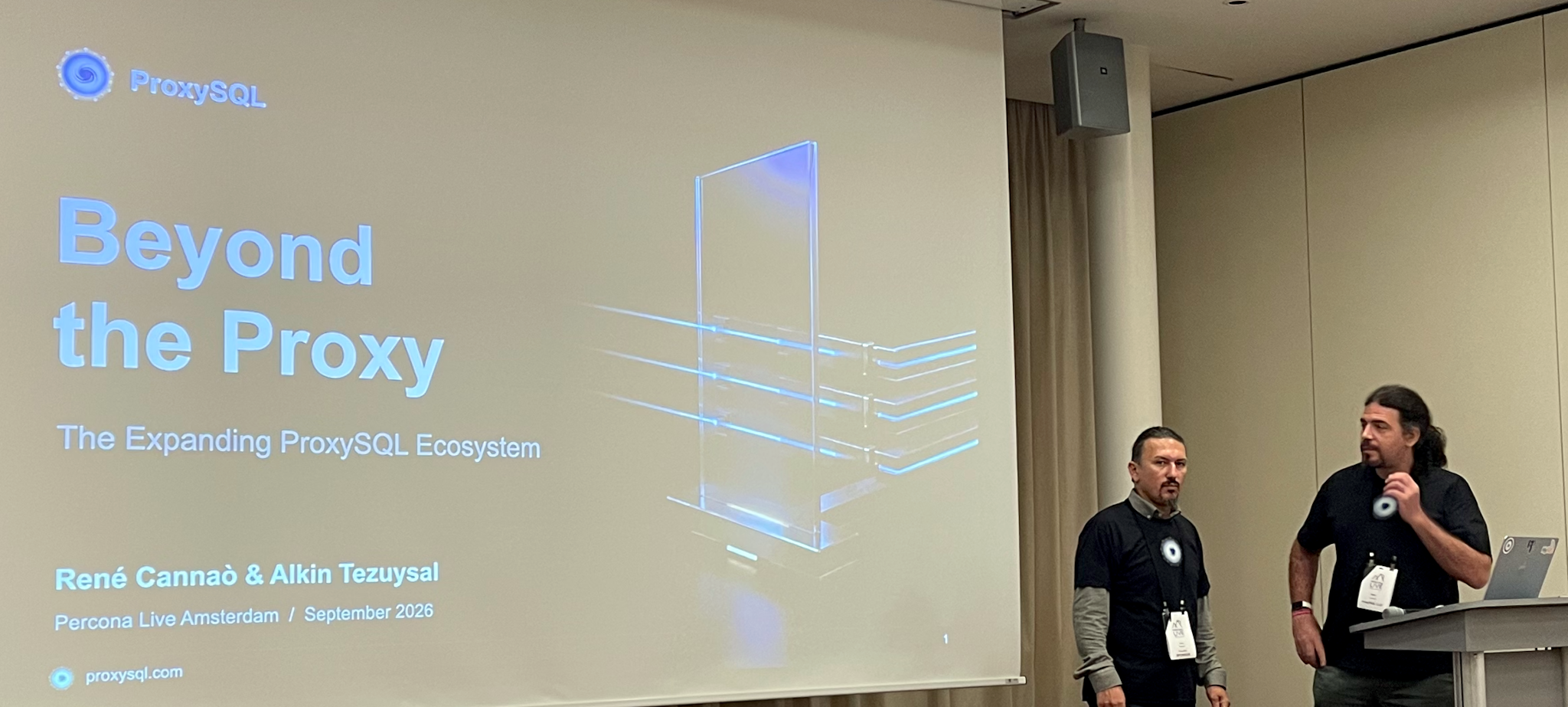
The next session 🎥 was by René Cannaò and Alkin Tezuysal of ProxySQL. ProxySQL is a protocol-aware database proxy that can help with things like connection pooling, read/write routing and failover. For reasons that will become clear later when I talk about MariaDB, I am very interested in solutions like this as they can be key to making database clusters perform well. I hope to have some time in the near future to play with this project.
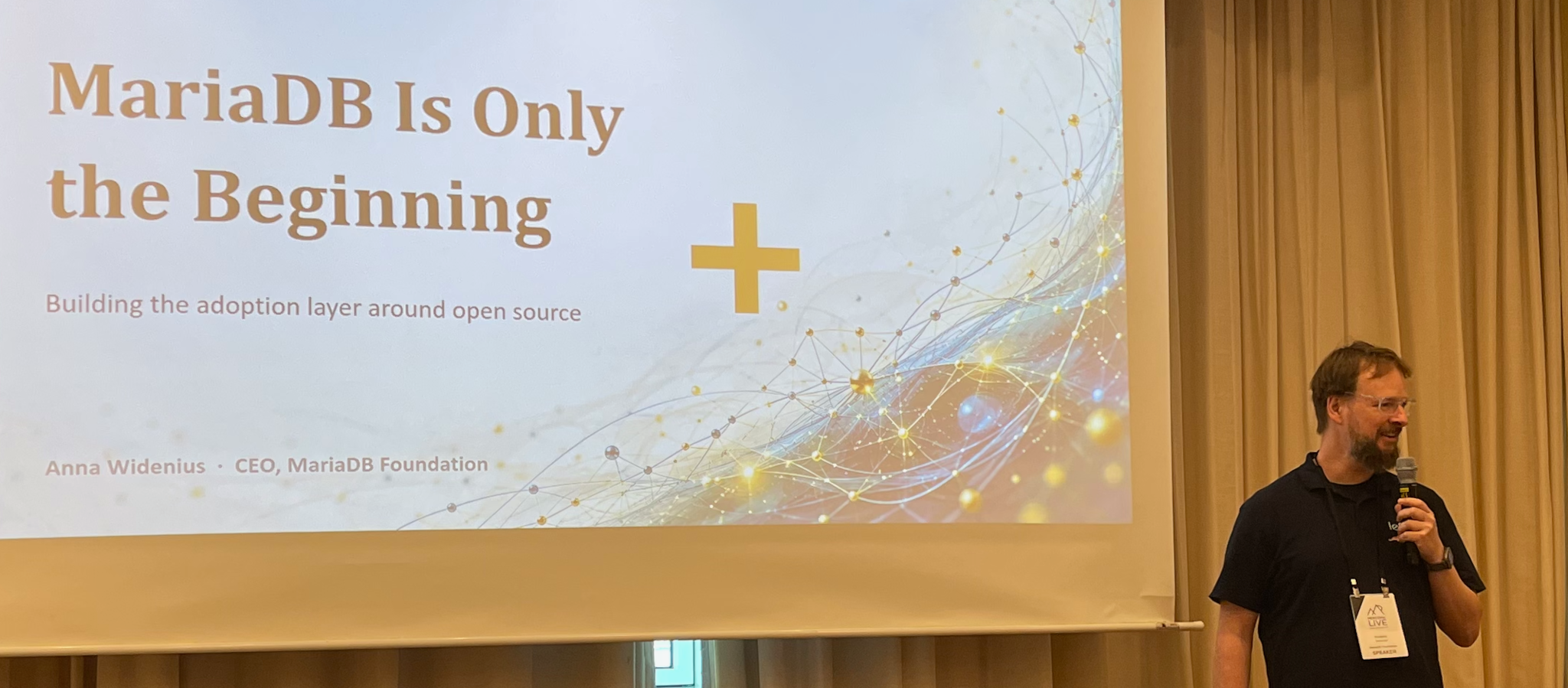
I was a little disappointed in the next talk since I was hoping to see Anna Widenius of the MariaDB Foundation. Unfortunately she was unable to attend so her talk, on increasing the adoption of MariaDB through contribution, was given by lefred. I did think it was cool that the background for the slides (a network of circular “nodes” connected in a mesh)
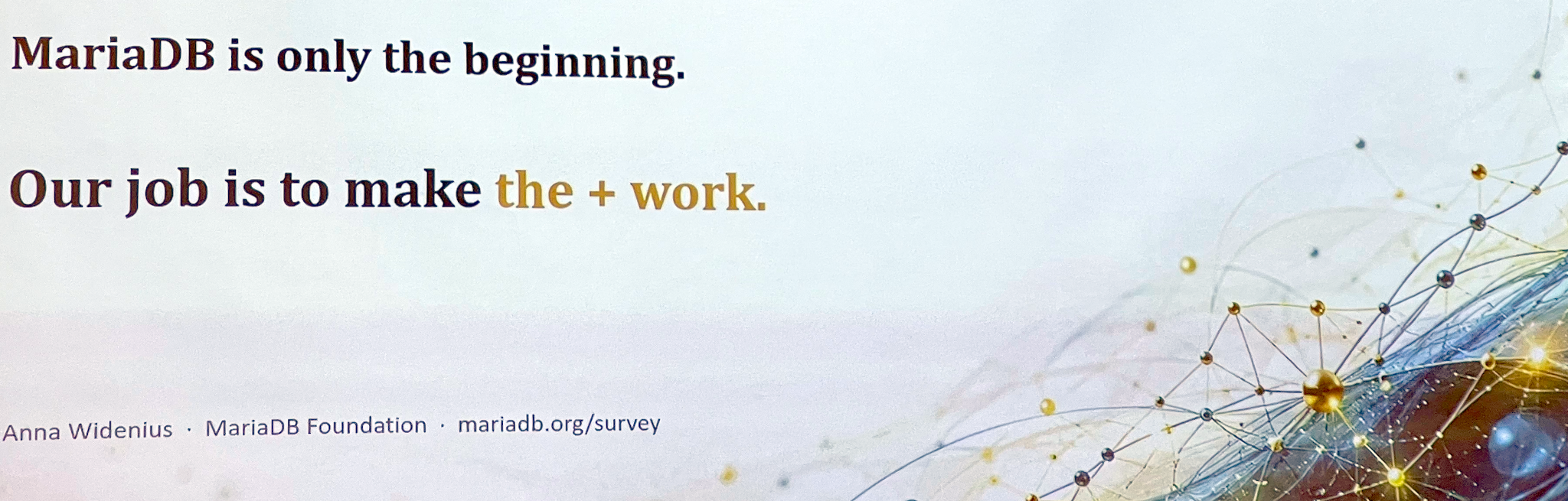
reminded me of an AI-upscaled version of design we used for OpenNMS back in the day:
Getting back on the topic of monitoring, which all the young’uns call observability to o11y, Kris Buytaert covered some useful tools.
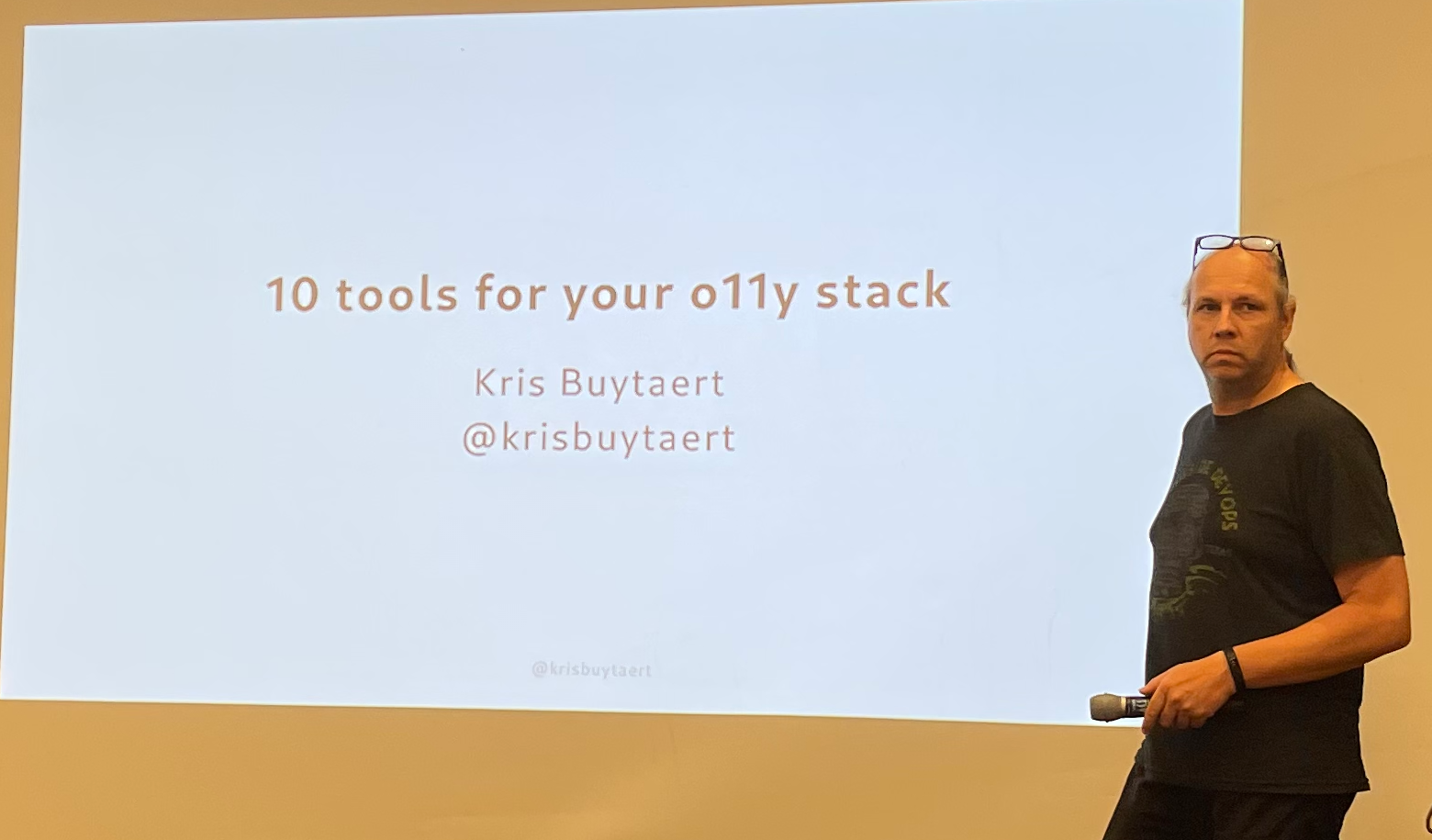
I just went and checked and the first conversation I had with him (via email) was back in February 2012. He really understands this field and I plan to check out some of the tools he discussed.
The final session 🎥 I attended on Thursday was by Henrik Ingo of MySQL.
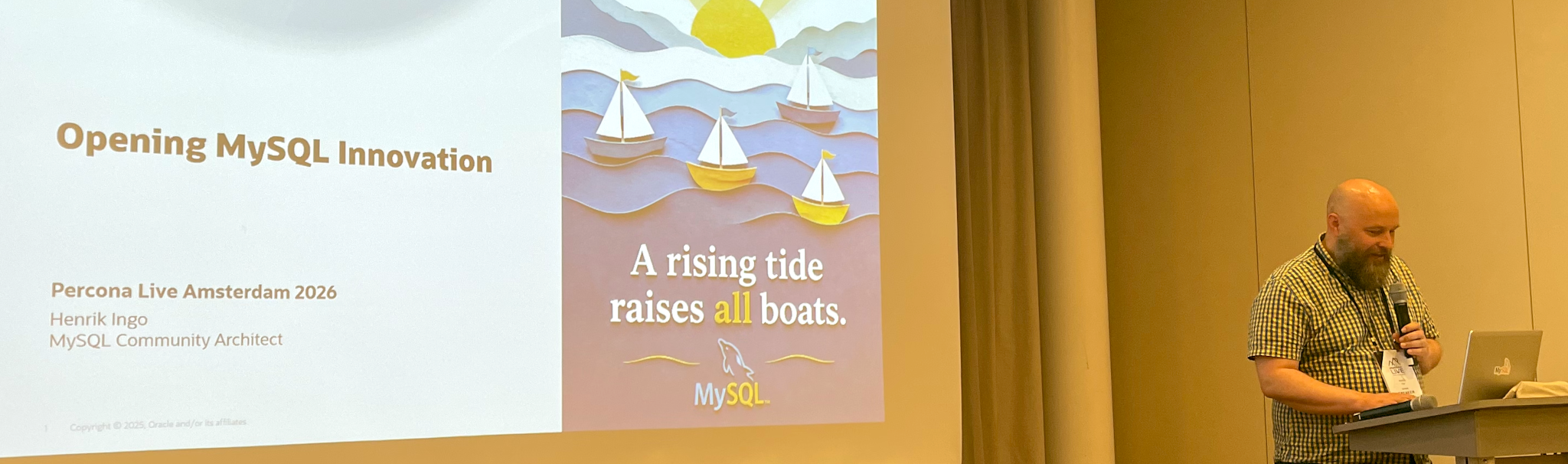
Now I am and will probably always remain a sceptic when it comes to Oracle’s stewardship of MySQL. I just don’t see a company that made billions, if not trillions, on a proprietary database investing a lot of resources in an open source database designed to compete with its main product. That said, I definitely hold no ill-will to those people at Oracle who are doing their best with MySQL and working to make the whole interaction with the community better. Henrick covered a number of positive changes that have been implemented this year, with more to come.
Thursday evening was the Speaker/Sponsor dinner, and I really enjoyed the conversations. The topics were wide-ranging but always interesting, and it is moments like those that mean the most to me when attending conferences.
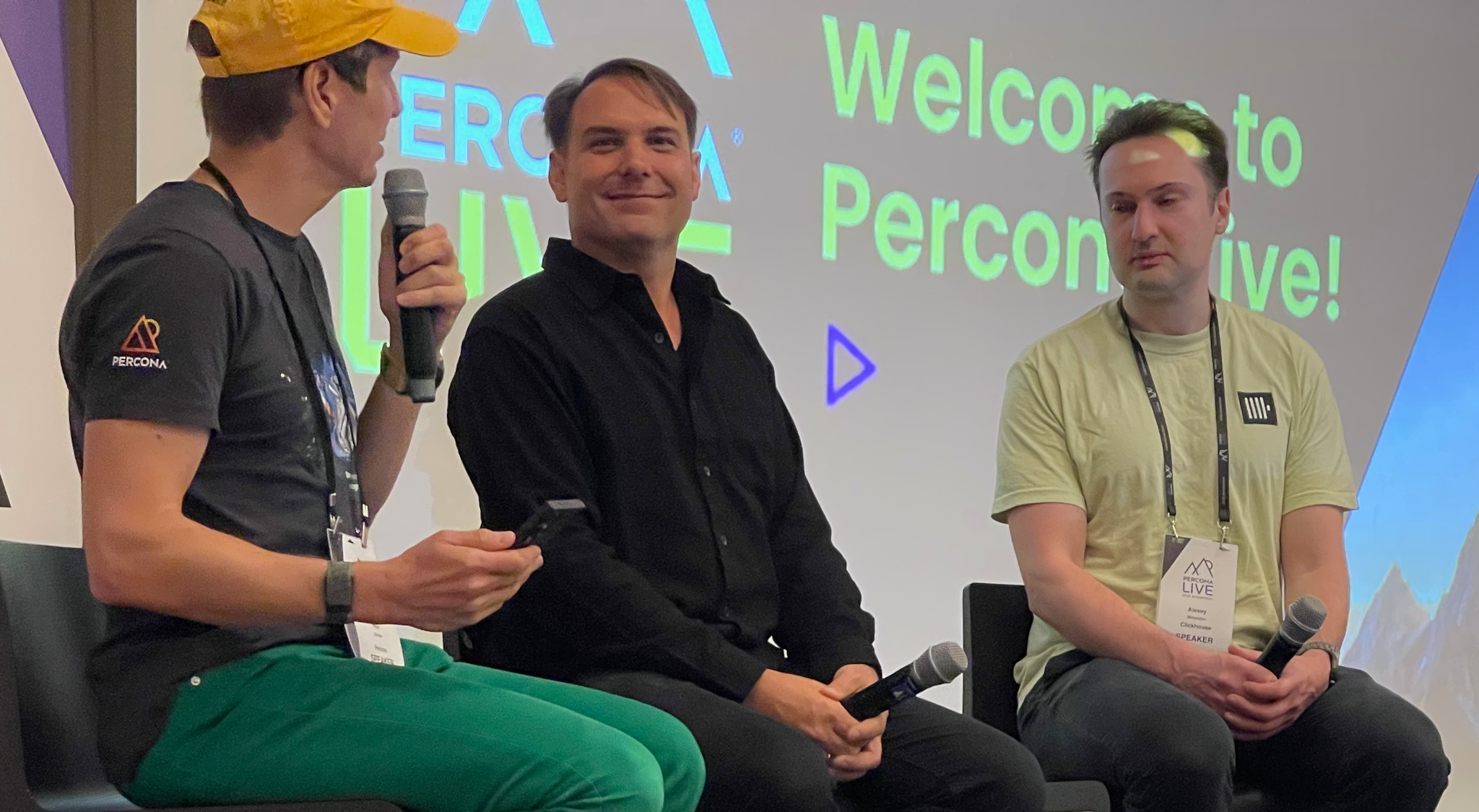
Friday morning’s keynotes kicked off with a fireside chat 🎥. Peter Zaitsev talked with Hannes Mühleisen of DuckLabs and Alexey Milovidov of ClickHouse about column-store databases.
Both DuckDB and ClickHouse are seeing a lot of interest from users, and ClickHouse has managed to hire two of my favorite people, Zoë Steinkamp and Amy Chen.
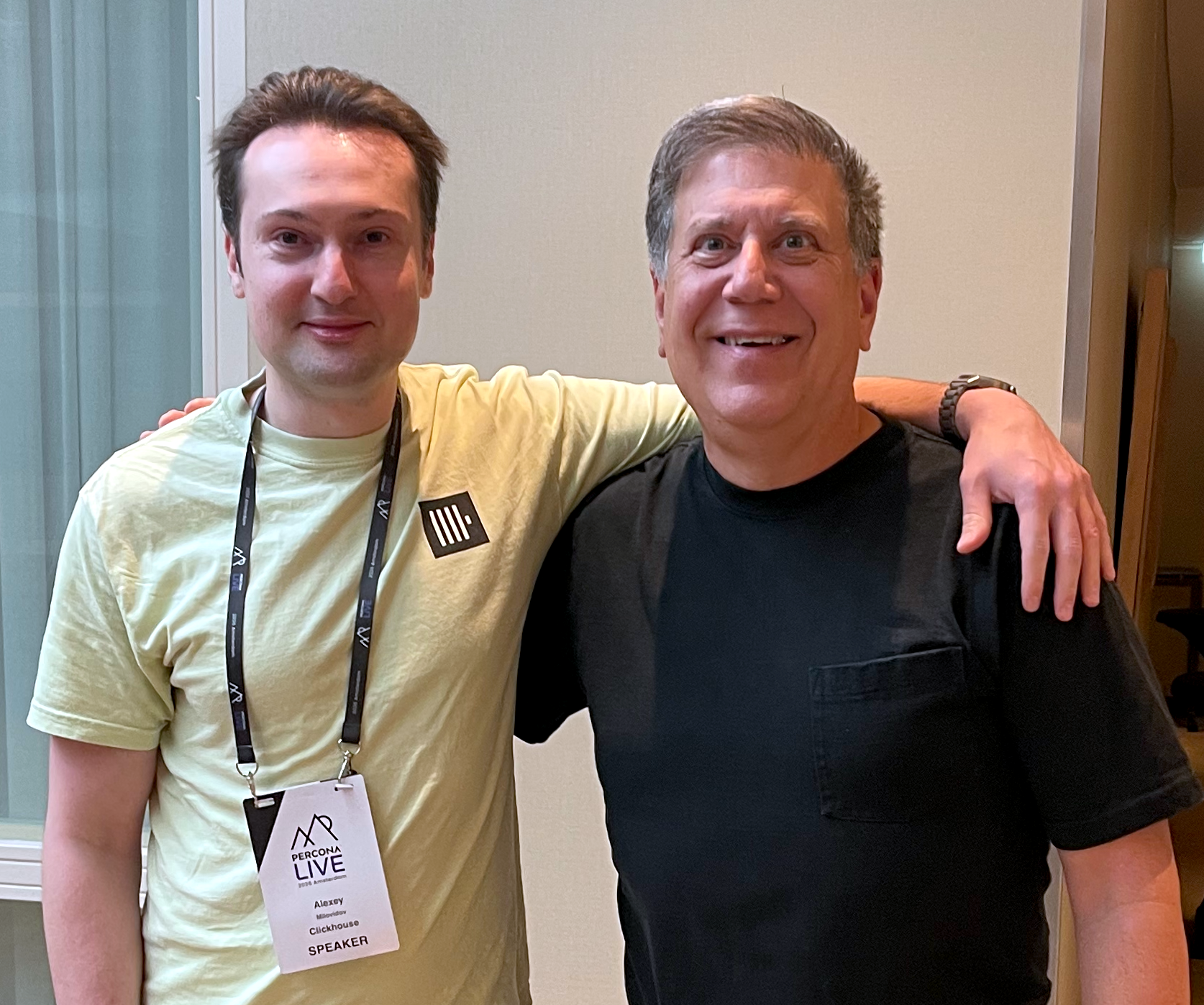
While I usually refrain from such things, I did ask for a picture with Alexey and he was kind enough to oblige.
Following the chat was a presentation 🎥 by Radek Szulgo on MongoDB, specifically for agentic use cases. Using open source databases is one way to bring Generative AI under user control.
Then came the worst keynote 🎥 of them all: mine. (grin)
I really hate talking about what I’m going to do. I would much rather talk about what was done, but since at this point I’d been at Percona about two months, that would have been a very short talk.
Percona is very eager to help customers get the most out of their open source databases, regardless of which database they choose. We have in-house MariaDB expertise and I am planning on hiring for several technical MariaDB roles, so one of my first orders of business as the GM was insure that our messaging shows MariaDB on par with our MySQL and PostgreSQL offerings.
Part of that was introducing the new logo. There is a lake out behind my house that occasionally hosts otters.

So the new logo features an otter.
Hats off to the team for coming up with it.
Also, by early 2027 I want to have a fully supported fork of MaxScale. While the current MaxScale has a proprietary license, previous versions were published under the Business Source License (BSL). This code reverts to the GPLv2 over time, and I want to fork and support the open source version moving forward. The usefulness of proxies, such as MaxScale and ProxySQL, that do query inspection has been proven and I want to make sure that our customers have access to them in an open source and supported fashion.
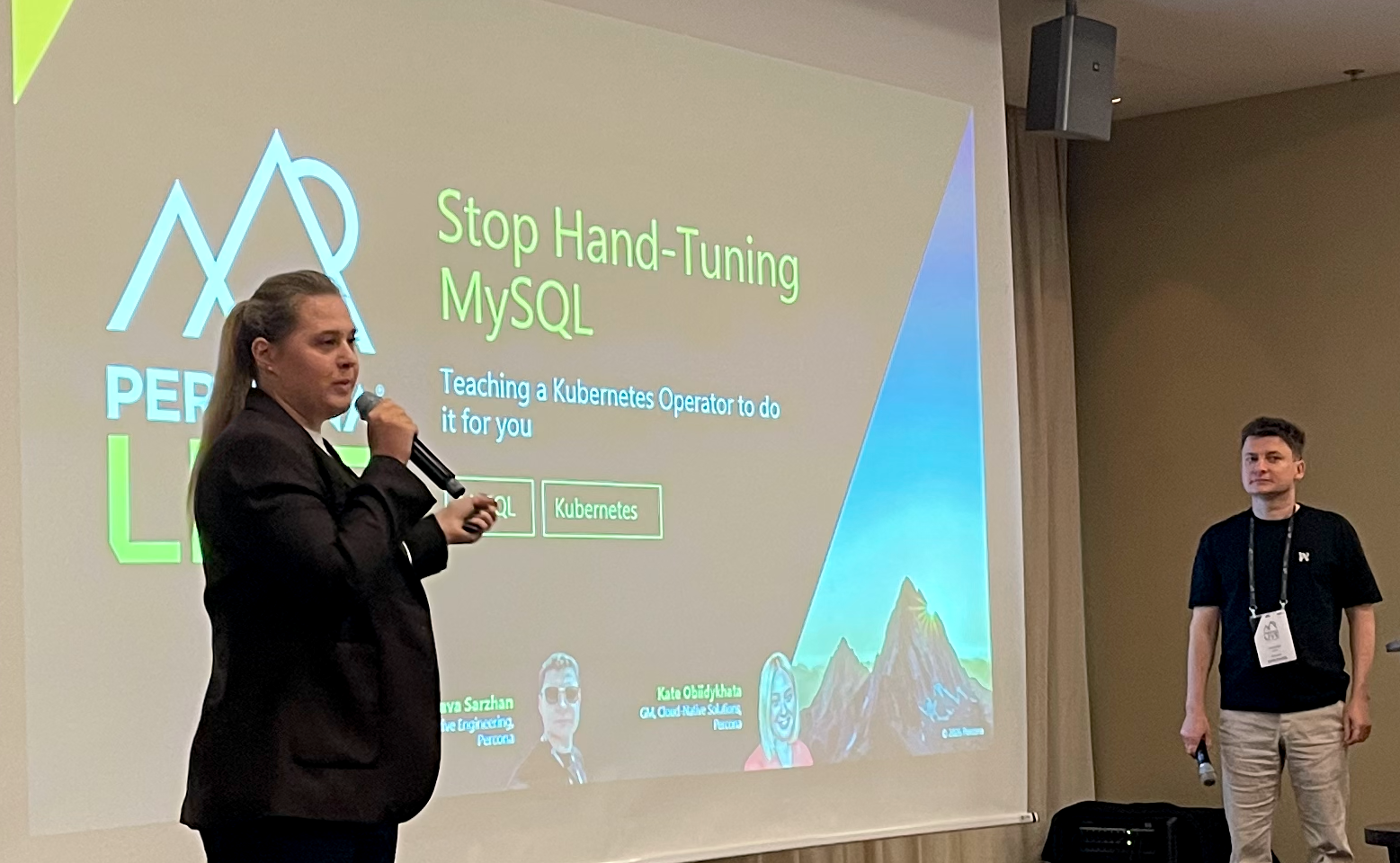
My talk was followed by a presentation 🎥 by Kate Obiidykhata and Slava Sarzhan on how to use the MySQL Kubernetes Operator to tune your MySQL parameters for you, instead of doing it by hand. Database performance can vary widely depending on how you set various variables. This talk discussed ways to automate the process for optimal performance.
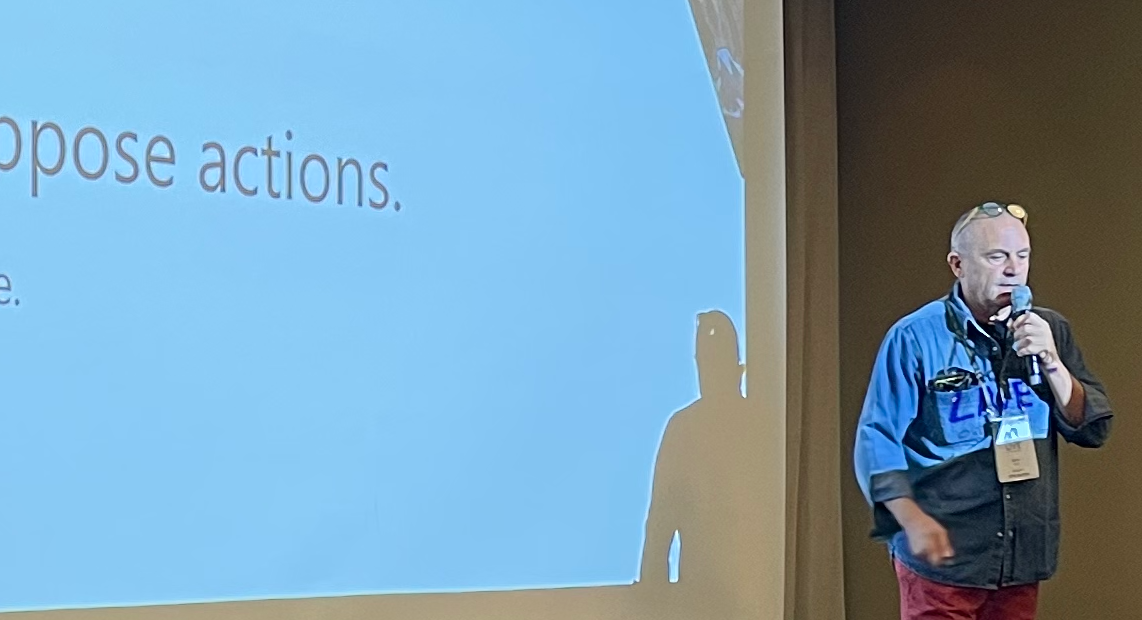
The final keynote 🎥 was supposed to be given by Dennis Kittrell but he had a last minute issue that meant he couldn’t make it to the conference. Instead, Marco Tusa gave a talk on why we do what we do, and it was a great way to close out the morning.
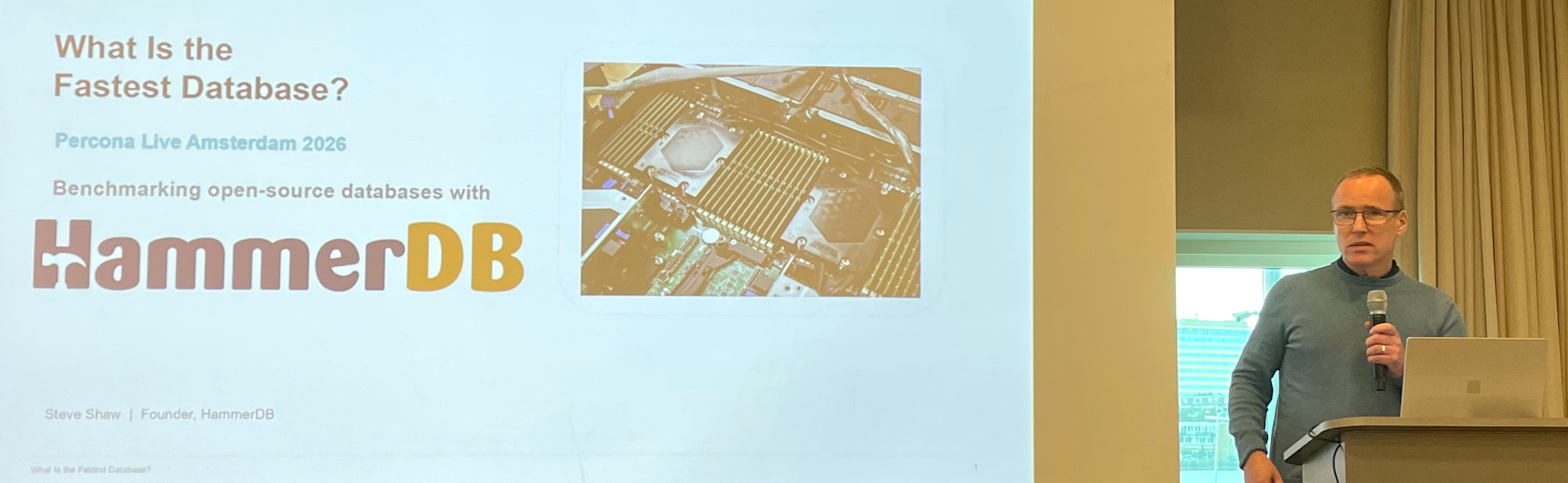
The last session I attended was given by Steve Shaw of HammerDB. I was eager to see this one for a number of reasons, not the least of which is that I talked his ear off at the Speaker/Sponsor dinner.
Steve specializes in answering one question: what is the fastest database? It is a tricky question, and he has created a project called HammerDB in order to be able to benchmark databases using real-world simulations.
I was really happy to see MariaDB do well in the tests, and in addition Steve has been working on the MariaDB Server for several months to improve its performance. HammerDB implements a workload derived from the TPC-C benchmark called TPROC-C. TPROC-C reports two metrics: NOPM and TPM.
The easiest way to understand NOPM and TPM is to think of the two metrics as the same you see on a dashboard. NOPM is how fast you are going, i.e. throughput, and TPM is how hard the engine is working to deliver that throughput.
NOPM stands for New Order transactions, whereas TPM measures the actual “commits and rollbacks” a database is processing.
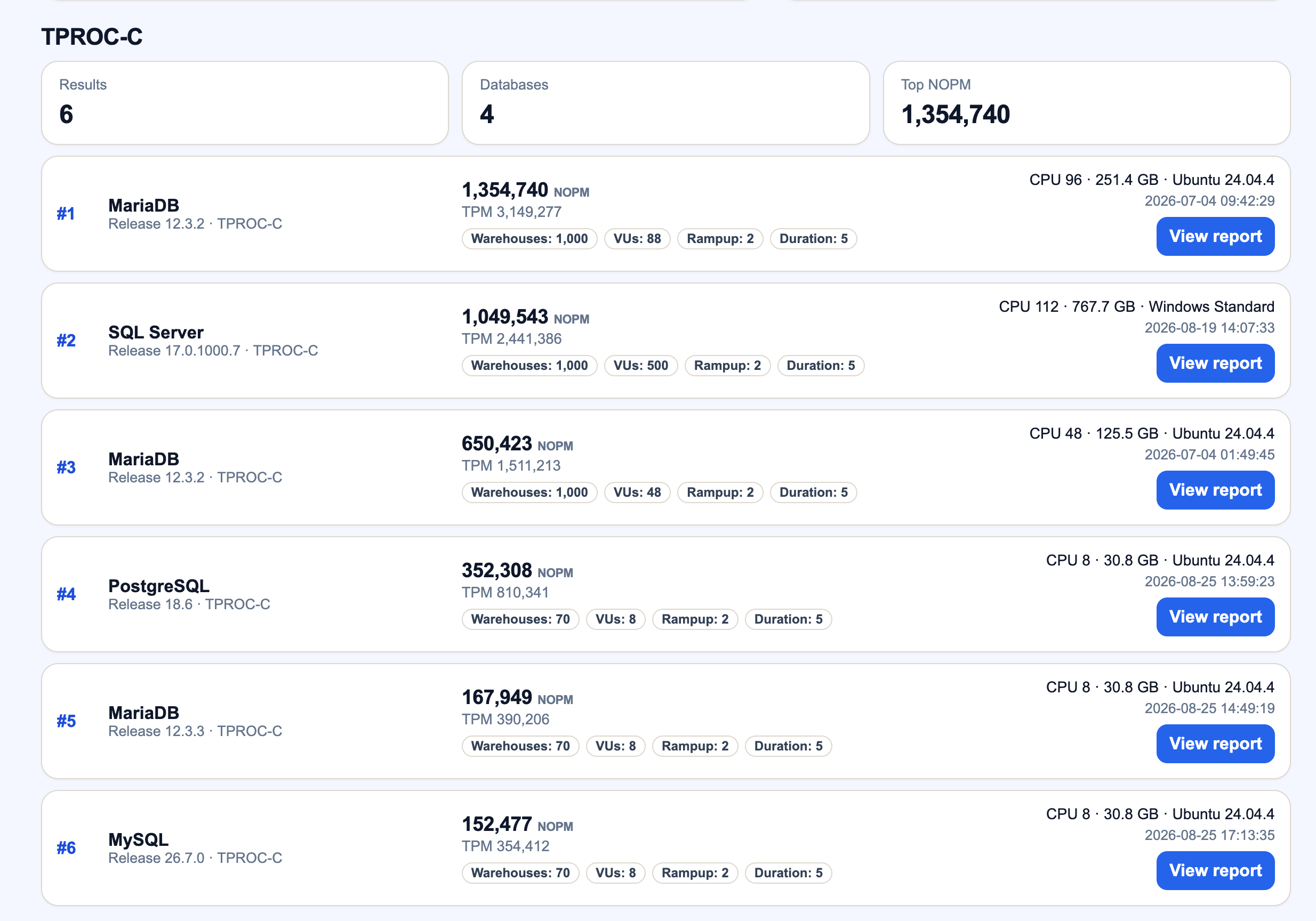
I went and took a screenshot of the user submitted results to the TPC using HammerDB, and MariaDB was at the top. Note the this was using 96 CPUs and 252GB of memory.
But benchmarks are hard, so I was very interested in the bottom three submissions. All three used 8 CPUs and about 32GB of memory, and in this case it looks like PostgreSQL is about twice as fast as MariaDB which is slightly faster than MySQL.
The reason I say benchmarks are hard is that there isn’t a run comparing the three databases at that high level, and I don’t have the funds at the moment to get a server with that kind of power (I think I’d rather by a nice used Ferrari). Do MySQL and MariaDB perform better than PostgreSQL when more cores are involved? I’d like to know. What we do know is that MariaDB does very well when there is enough hardware.
I spent the rest of the conference in the hallway track once again. From May until this conference I didn’t travel at all and I kinda liked it. However, it was definitely worth the travel to spend time at such a great event.
It made me ask if we could do more Percona Live events. We have the US and Europe covered, but perhaps we could do one in South America, Africa and Asia? Time will tell, but I know that the event will be back in the US next Spring and Europe in Autumn.
Hope to see you there.