Today marks the start of my fourth week at Percona and these few weeks have been, well, exciting to say the least.
I was hired to manage and develop our business around MariaDB Server. Percona has long been recognized as a leader in customer-focused solutions around MySQL, and we want to extend those same values to the MariaDB Server ecosystem.
One of the things I love about Percona is that it is a company that embodies open source ideals, including encouraging people to speak their minds. One of the hardest things about my time at AWS were the tight controls over all messaging, but now in my new job I can post stuff like this on my blog without fear of repercussions. (grin)
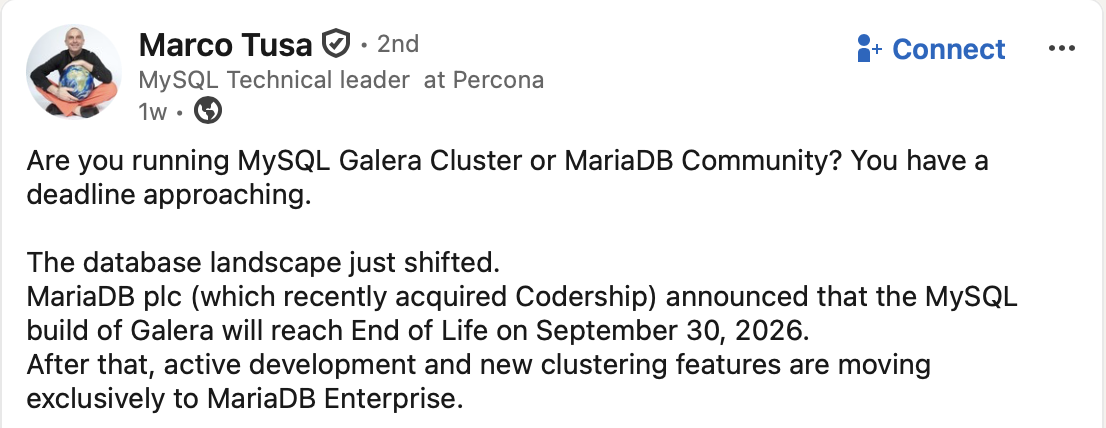
Last week my life got “interesting” when my teammate Marco Tusa published a post on LinkedIn which started out:
Are you running MySQL Galera Cluster or MariaDB Community? You have a deadline approaching.
If engagement is what you are after, that is a pretty catchy opening line.
While everything Marco says is factually true, the way the post is written can be misleading if you don’t have an in-depth understanding of the situation.
[Note: if you are not running Galera Server for either MySQL or MariaDB Server, your life is not going to change in the near term, so ignore the rest of this post]
It is true that on September 30th, 2026, the official support for Galera Cluster on MySQL will end. That isn’t very far off, but it was announced by the MariaDB Corporation on December 1st of last year, so we’ve known about it for some time.
MariaDB plc acquired Codership Oy, the company that created Galera, in May of 2025. They have made the business decision to build a proprietary software offering based on Galera which will become part of their MariaDB Enterprise Platform.
What does this mean if you run Galera on MySQL? Well, on October 1st your instances will not change one bit. Everything that used to work will still work, but the Galera portion will be unmaintained. This means that if you migrate to a future version of MySQL, or if a security issue is discovered on October 2nd, you will not get any support from the previous Galera maintainers.
What about if you are running MariaDB Server?
First, since the term “MariaDB” can get confusing, I refer to the open source MariaDB database as “MariaDB Server”. This is the preferred term used by the MariaDB Foundation, but you will see the Corporation use “MariaDB Community Server”. I hate the term “community version” as it implies that it is somehow lesser than other versions. In the case of MariaDB Server, while it may not contain all of the features of the MariaDB Enterprise Platform, the code that makes up the server application is based on MySQL and must be published under the GPLv2 license (well, unless you are Oracle and own the copyright).
Anyway, if you are running MariaDB Server and a security issue is discovered on October 2nd, you can reasonably expect it to be resolved. Galera will remain an active MariaDB Server subsystem and is currently maintained by Seppo Jaakola. As part of his role you can expect security issues and changes to the main database that impact the Galera Cluster to be addressed.
What is changing, and what is the main source of confusion, is that future feature development for the Galera Cluster will be focused on the plc’s Enterprise Platform. That is the option of the MariaDB Corporation. I don’t have to like it, but in open source people are free to choose what they do and do not contribute (within licensing restrictions, of course) and the plc has no obligation to make all of their software free.
But this does represent an opportunity for us as users of open source software.
One of the key changes I am working on as the General Manager of MariaDB at Percona is to become much more involved in contributing code to the project. If MariaDB plc makes a new feature exclusive to the Enterprise Platform that you think is useful, let us know. Perhaps we can make something similar for MariaDB Server.
I want to point out that MariaDB plc has a vested interest in the success of MariaDB Server (unlike, for example, Oracle and MySQL). To this day they are still, by far, the number one code contributor to MariaDB Server.
Despite the overwhelming involvement of the Corporation in the Foundation, the community does work. Back in March, Jepsen published a post on issues they had uncovered with the Galera Cluster. They ended up opening four tickets, and I just checked on the status. MDEV-38974 was closed with a documentation update. MDEV-38976 is still open. MDEV-38977 has a solution in testing, and MDEV-38999 is still open but with some potential workarounds.
All of these “MDEV” tickets are for MariaDB Server and indicate that Galera is still an active component in the database. It would be nice if they could all be fixed rapidly (the two open ones seem to have stalled) but this represents an opportunity for Percona and for the community as a whole.
So, just to summarize my thoughts on Marco’s post: If you are running Galera Cluster on MySQL you really need to consider some form of migration. That can be to Percona Server for MySQL and PXC (and while I’m biased, if you are running MySQL you really should be running the Percona Server version), to MariaDB Server, or to the MariaDB Enterprise Platform, but your database is not going to keel over and die on October 1st if you do nothing.
If you are running MariaDB Server (or MariaDB Community per Marco) nothing will change for you.
No matter what database you are running, Percona would like to be your trusted partner. If you are going to have to migrate we can help you determine the best path. If you want to stay on MySQL we can help with that, and if now is the time to try out MariaDB Server, we can help with that as well.