First off, apologies for the click-baity title, but as this year marked the fourth re:Invent since I joined AWS I wanted to reflect on a major change it has made on my life - specifically how I celebrate the end of the year holidays.
In the US the winter holiday season tends to start with Thanksgiving, which occurs on the fourth Thursday of November. We used to spend the following weekend decorating the house for Christmas, and it really put me in the mood for the holidays.
These days I travel to Las Vegas that weekend, spend a hectic week at re:Invent, and then I need least a week to recover. Since it takes a lot of work to put up decorations, I find I don’t want to do it if they are only up for a couple of weeks, so I skip it entirely.
I’m not sure why the week after Thanksgiving was chosen for re:Invent but I think in part it is because no one else would schedule a big conference for the same time.
For me, re:Invent is kind of like the original Star Trek movies - the even ones are good. I missed my first re:Invent opportunity in 2022 because of H5N1, and for my third in 2024 I was exposed to COVID and got sick on Day One.
This year I managed to stay healthy, and despite having a less than stellar experience with my hotel (the Paris), I had a good time overall. Our group, Open Source Strategy and Marketing (OSSM), does a buy-out of a restaurant so there is a place to get out of the overall re:Invent chaos and to host a lot of open source-focused meetings.
While the re:Invent keynotes kick off the show Tuesday morning, for the last two years Doug Cherry and his team have hosted a commercial open source business panel on Monday afternoon. This year we had a great lineup of speakers, including Samar Abbas (Founder of Temporal), Taylor Otwell (Founder of Laravel), Matthieu Lavergne (Serena Capital), and Stormy Peters, my manager at AWS.
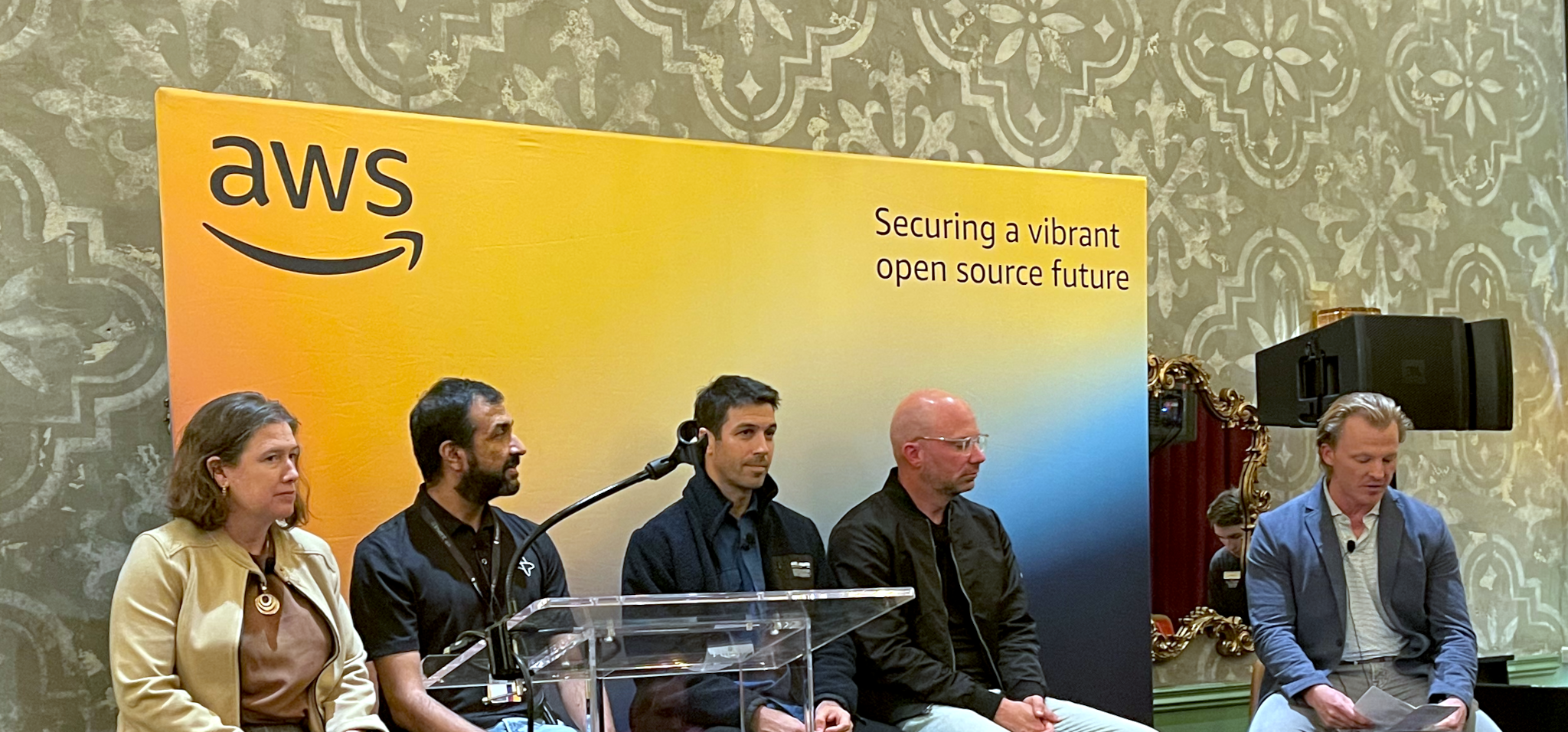
As someone who ran an open source business, I am very aware of the challenges between balancing staying true to open source ideals and trying to keep the lights on as a company. After trying various business models for 20 years I found that when it comes to open source people will pay for three things: simplicity, security and stability. Provide one or more of them and people will pay you for it.
Temporal builds an open source “durable execution” platform that lets you run long‑lived, reliable workflows in code without worrying about failures, retries, or state management. Their software is permissively licensed (MIT) and you can self-host it for free. But if you want someone to handle the heavy lifting, you can opt for Temporal Cloud. The billing model (while offering a number of options) is ultimately based on consumption. You pay for what you use. This would beat a self-hosted instance where you may not have enough capacity for dealing with a surge of actions or you would end up with idle capacity when not in use.
This panel provided a great opportunity to hear from Samar Abbas about why he made the business decisions he did. We also got to hear from Taylor Otwell of Laravel.
Laravel is a free, open source PHP web application framework that helps developers build, deploy, and maintain modern web apps more quickly and reliably. Why the more popular “P” programming language these days is Python, folks need to remember that the modern Internet was built on the “LAMP” stack where the “P” stood for PHP. A lot of PHP development is still going on (I use NextCloud multiple times a day for example) and the Laravel Framework makes it much easier to do so, especially when faced with issues of scale and reliability. The framework allows developers to focus on the business logic of their applications and not infrastructure. The framework is also MIT licensed.
Laravel has a number of products including Vapor. Vapor is a serverless offering that lets users abstract away a lot of work in making a AWS Lambda application.
Again, users get choice. Built your own or pay for simplicity, security and stability.
I also really enjoyed hearing from Matthieu Lavergne. When I got involved in open source at the turn of the millennium, it was hard enough to get customers interested in running open source, much less outside investment into companies building on open source. Serena came with the receipts. In “The Open Source Payoff” Lavergne writes:
The debate is no longer about whether Commercial Open Source works — it does. The next real question now is where it wins next, and how.
The whole panel was awesome and it was a great way to kick off re:Invent.
The rest of the week went by in kind of a blur. As I mentioned I stayed healthy, which was cool. The team I’m on rolls up under Developer Experience, and I spent some time on the show floor in the open source booth. The section set aside for Builders could be found by looking for the big duck.
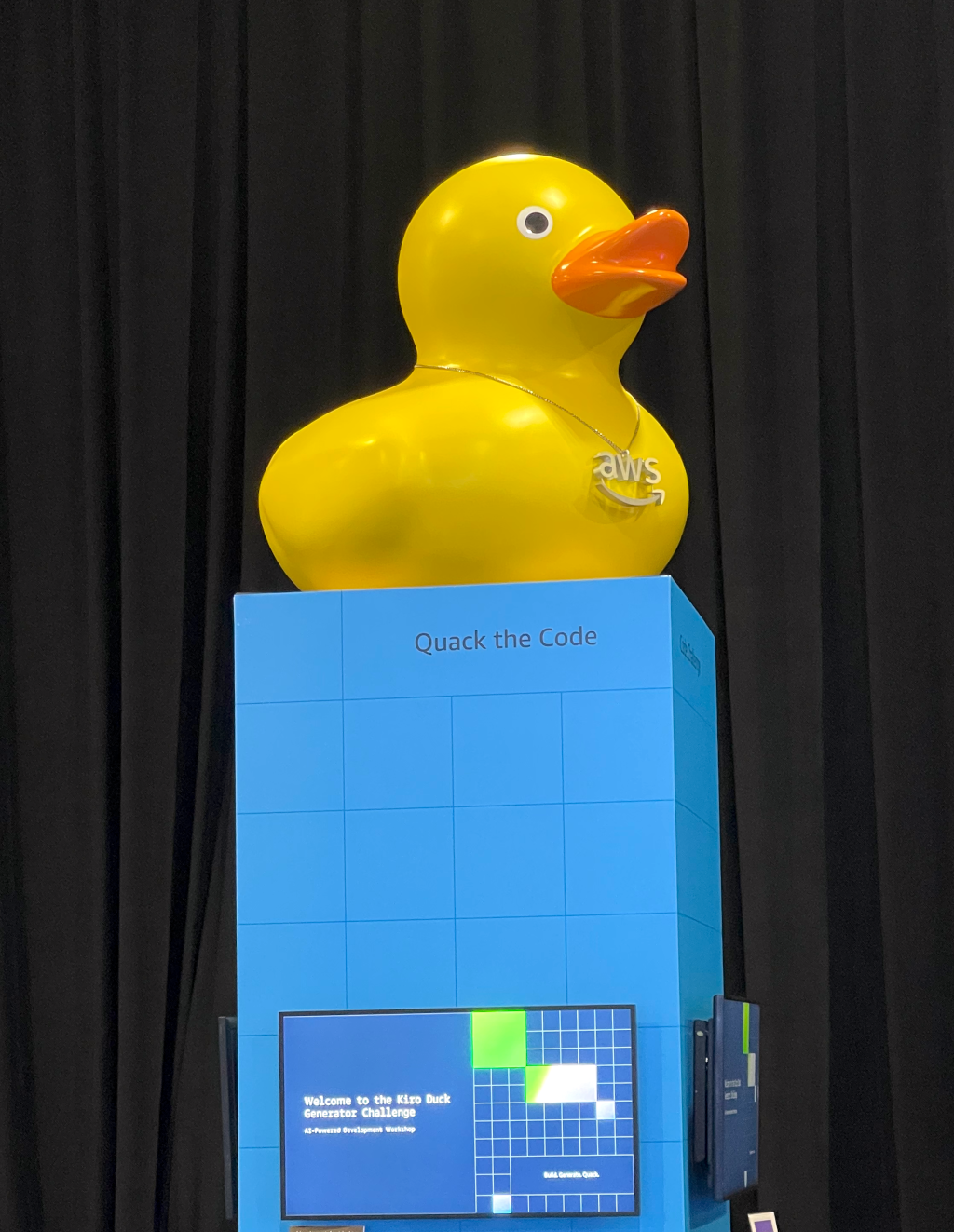
AWS had a bunch of nice swag opportunities available for attendees, and to earn it you had to visit a number of booths in the area. It was awesome to be able to interact with so many people from all over the world (and I got to practice my meager foreign language skills).
I also got to come up with two cocktail recipes for our “hangout”.
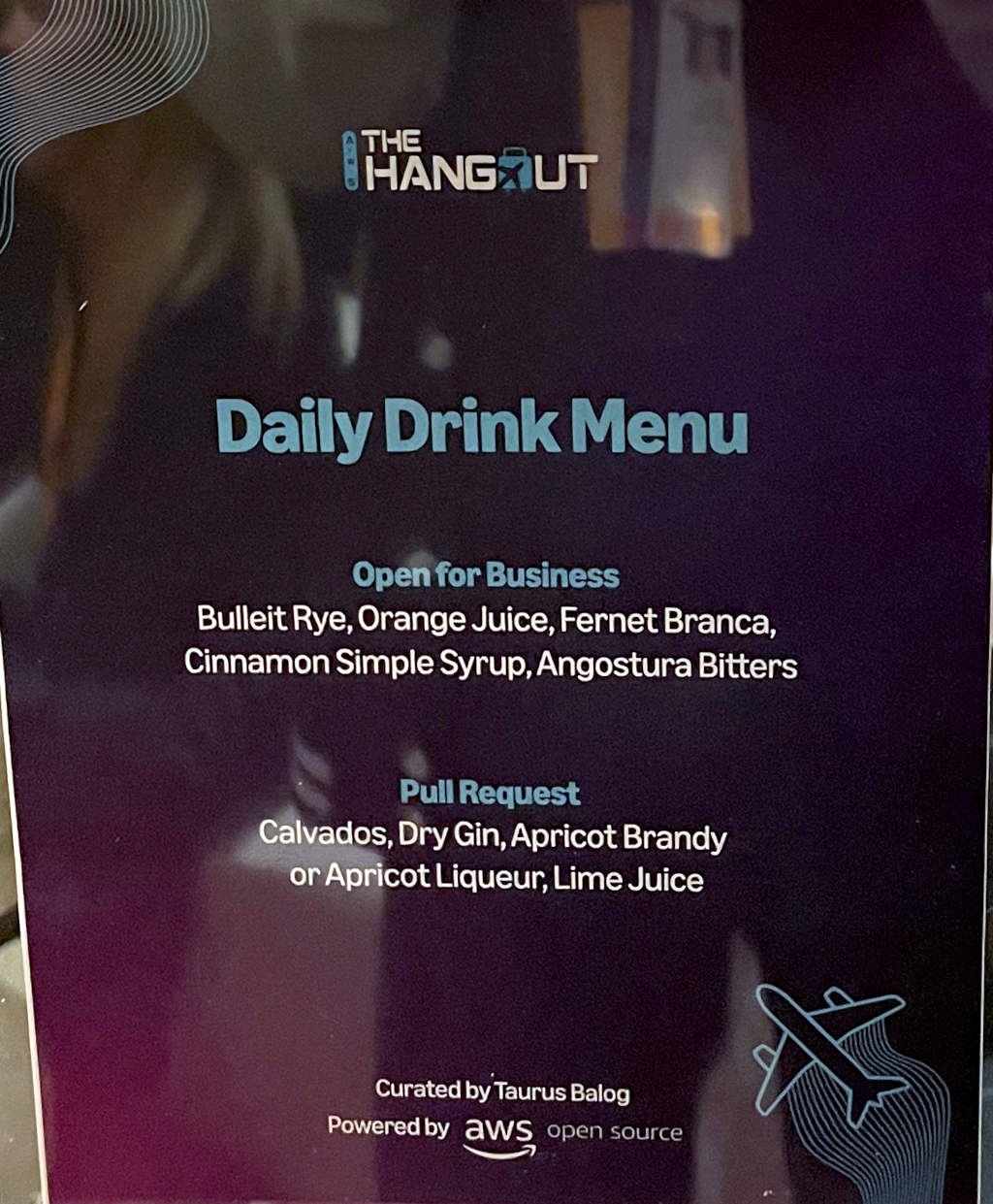
I think they turned out well, although I preferred Open for Business more than Pull Request. You might be wondering why I had to wait until re:Invent to evaluate them but this was the first time I had tried them. I was asked to come up with some cocktail recipes at a team meeting and I didn’t have time to test them. The bartenders at our restaurant approved, though, so they ended up on the menu.
I also got to meet Corey Quinn for the first time. I read his “Last Week in AWS” blog, although he is growing his hair out so I almost didn’t recognize him. He was wandering around with my friend Darko Mesaroš and so I got an introduction.
We also crossed paths again when his company sponsored an off-strip event with the analyst firm Redmonk. I really enjoy working with the whole Redmonk team and James Governor was kind enough to give me a copy of his new book: Progressive Delivery.
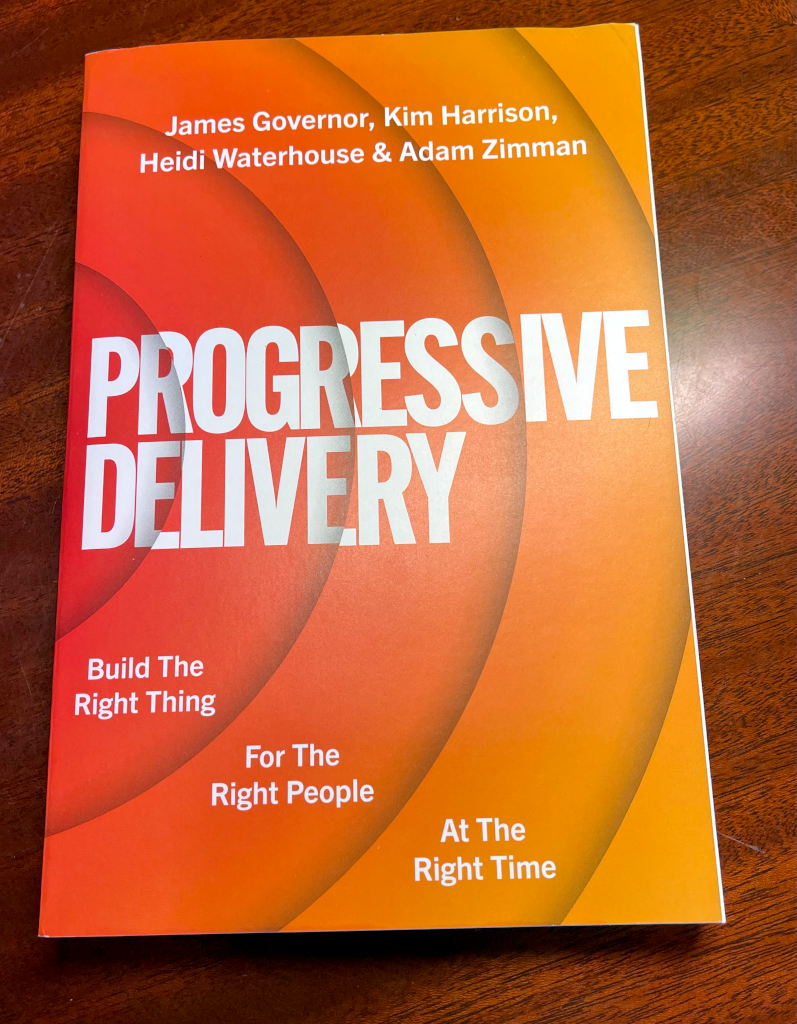
I am now just finding the time to read it, and I’ll post a review when I’m done.
As someone who lives in a national forest ten miles from the nearest gasoline station, coming to Vegas is a bit of a challenge. But I had fun, and more importantly it looks like the customers who came to re:Invent had a good time as well.